Radar check
What we found when we opened it. Every bar is one fact, with its date.
Last code pushed 26 Oct 2026, the same day before this check.
Latest release v3.19.0 on 7 Oct 2026.
Public since April 2019, a little over 7 years.
8,048 stars and 725 forks.
368 commits and 67 new issues in the last 90 days.
689 contributors. 328 pull requests merged in 90 days.
A security policy says how to report a problem. 5 published security advisories.
How the bars are scored
- Alive. Days since the last code push: a week or less 100, a month 90, three months 70, six months 50, a year 30, eighteen months 15, older 0.
- Releases. Age of the latest GitHub release, on a similar scale; no bar when the project publishes no releases.
- Maturity. Age of the project: eight years 100, five 90, three 70, two 55, one 40, six months 25, younger 10.
- Adoption. Stars on a log scale: 100,000 stars is 100, 10,000 is 80, 1,000 is 60, 100 is 40.
- Activity. Commits in the last 90 days: 300 or more 100, 100 85, 30 65, 10 45, any 25.
- Community. People who have contributed: 100 or more 100, 30 80, 10 60, 5 40, 2 25, one 10.
- Security. A published security policy 80, none 40; published advisories are listed, not scored.
Checked by Repo Radar on 26 Oct 2026 from the repository on GitHub.
In simple English
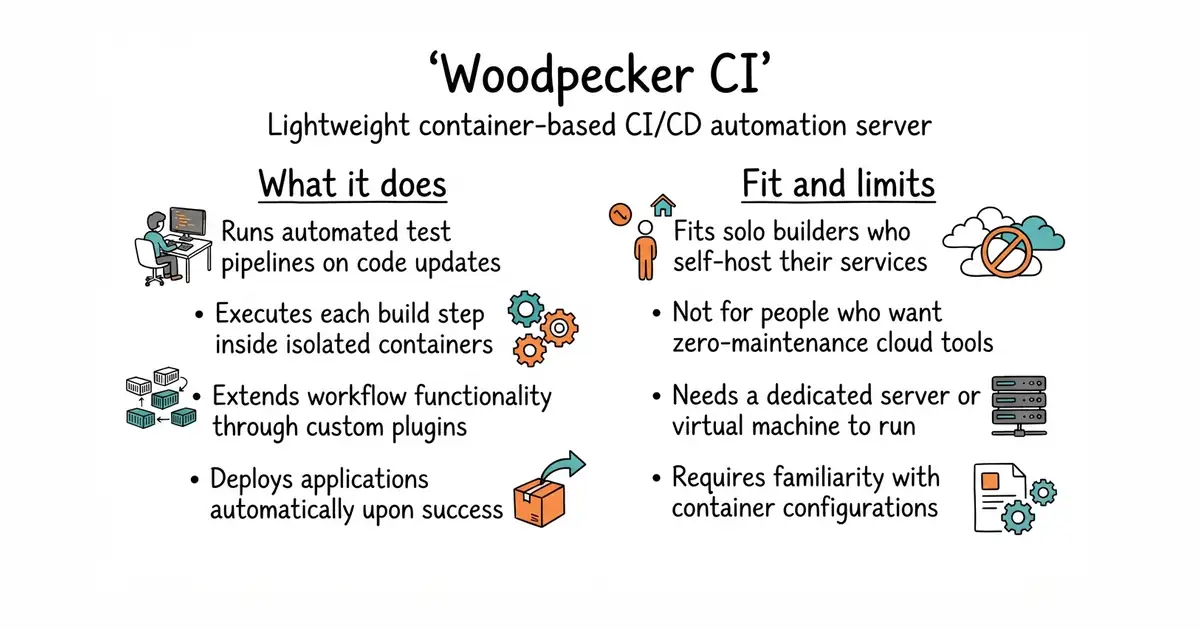
This tool runs your tests and software builds automatically whenever you save changes to your code. It checks every update to make sure nothing is broken before you share it with users. You run it on your own server instead of paying a large monthly cloud service for the same job. It costs you time to set up and manage, but nothing in money fees. It uses very little memory and works well on small servers.
What it is
Woodpecker is an open-source automation engine (a program that runs a set of automated steps when code changes) that runs as a server and separate workers. It handles tasks like testing code and building Docker (a way to run a program inside its own sealed box, so it cannot break anything else on your server) images.
What it is good for
Solo builders who want a fast and private way to test and deploy software without paying heavy monthly fees for commercial build tools.
- Runs on very little memory, needing only 100 megabytes for the server and 30 megabytes for the agent when idle.
- Connects easily with popular code hosting services like GitHub and Codeberg.
- Offers a large ecosystem of plugins to handle deployments, notifications, and code checks.
- Requires technical skill to set up and maintain a self-hosted build server.
- Needs a separate database like SQLite or PostgreSQL for storing build history.
- Troubleshooting failed builds requires checking logs directly on your own infrastructure.
GitHub Actions or hosted cloud build services
Docker
- harness/harness39k stars
Drone is the older container-based automation engine that Woodpecker was forked from.
- go-gitea/gitea59k stars
Gitea is a self-hosted Git service that often pairs with this tool for complete private code hosting and building.


- traefik/traefik65k stars
Decides which program answers each incoming request, and builds the rules by watching where the programs are.
- rajnandan1/kener5.2k stars
A status page you run yourself, which checks your services and shows their recent history.
- caprover/caprover15k stars
A web page that installs apps and databases onto one rented computer, and sorts out the addresses and certificates.
docker run \
  --volume /var/lib/woodpecker:/var/lib/woodpecker \
  --volume /var/run/docker.sock:/var/run/docker.sock \
  --publish 8000:8000 \
  --env WOODPECKER_OPEN=true \
  --env WOODPECKER_HOST=http://localhost:8000 \
  --name woodpecker-server \
  woodpeckerci/woodpecker-server:latest