62.4k stars · MIT · astro@7.3.1 (2026-09-03) · Track this in Rising ↗
Static, content-first web framework — the part of the site that can actually rank, because the React SPA cannot.
Radar check
What we found when we opened it. Every bar is one fact, with its date.
Last code pushed 27 Oct 2026, the same day before this check.
Latest release @astrojs/vue@7.1.2 on 21 Oct 2026.
Public since March 2021, a little over 5 years.
63,518 stars and 3,879 forks.
540 commits and 291 new issues in the last 90 days.
1,257 contributors. 515 pull requests merged in 90 days.
A security policy says how to report a problem. 47 published security advisories.
How the bars are scored
- Alive. Days since the last code push: a week or less 100, a month 90, three months 70, six months 50, a year 30, eighteen months 15, older 0.
- Releases. Age of the latest GitHub release, on a similar scale; no bar when the project publishes no releases.
- Maturity. Age of the project: eight years 100, five 90, three 70, two 55, one 40, six months 25, younger 10.
- Adoption. Stars on a log scale: 100,000 stars is 100, 10,000 is 80, 1,000 is 60, 100 is 40.
- Activity. Commits in the last 90 days: 300 or more 100, 100 85, 30 65, 10 45, any 25.
- Community. People who have contributed: 100 or more 100, 30 80, 10 60, 5 40, 2 25, one 10.
- Security. A published security policy 80, none 40; published advisories are listed, not scored.
Checked by Repo Radar on 27 Oct 2026 from the repository on GitHub. Covered in Edition 3.
▶Repo detailsthe review · specs · pros & cons · install
What it does
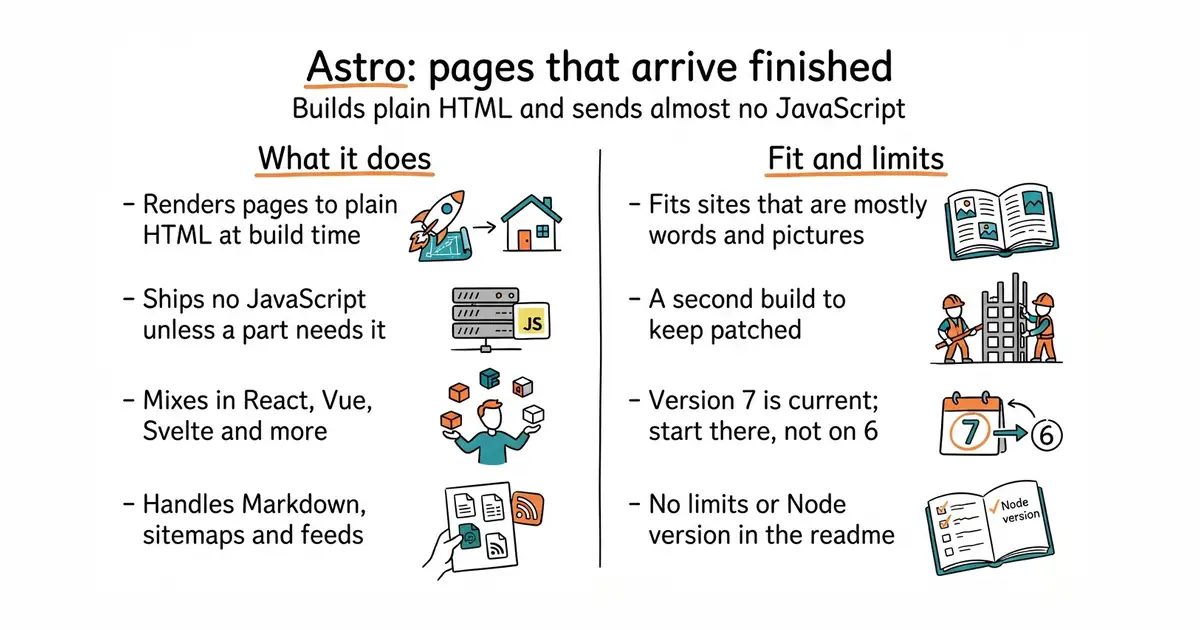
You describe pages in files, and it renders them to plain HTML at build time. By default it ships no JavaScript to the browser at all, and interactive components are opted into one at a time. It has official connections to the interface libraries people already use, with React, Preact, Solid, Svelte and Vue all named, and to the common hosting services, with Node, Vercel, Cloudflare and Netlify all named. It handles Markdown and MDX, sitemaps and feeds, so a blog and a documentation section need no extra machinery. It ships editor support as well: a language server, a TypeScript plugin, a Visual Studio Code extension and an astro check command that type-checks a site. The repository is a monorepo of 20 published packages with 14,861 commits on its main branch. What it does not do is state a single limitation in its README, and it does not state a minimum version of Node.js anywhere on that page either, which leaves both to the documentation site.
Why it matters
Who it suits. Anyone whose public pages are mostly words and pictures, and who wants them to arrive quickly and be readable by anything that fetches them. It fits a documentation site, a blog, a marketing section or a set of generated pages particularly well. It also fits a team that has an interactive application already and wants the readable pages in front of it, because the two can live at different addresses. Skip it if the thing you are building is one highly interactive screen, because then almost every page needs the JavaScript this framework exists to avoid sending.
Verdict. Worth a weekend if public pages matter, and it is the most popular project in the set at 62,220 stars. The version claim in this edition was the one fact that had gone out of date: version 7 is now the current release, 7.3.8 at the package registry, and the advice to start on version 6 is withdrawn. Start on 7. Two honest costs. A second way of building pages is a second thing to keep patched, and keeping one visual identity across two builds takes discipline or the result looks stitched together. And the repository is busy in a way that matters when you pick a version: 20 packages, 90 open pull requests, and a release on 8 October 2026 for one of its hosting packages. Code landed on the framework itself on 1 September 2026. If you prefer no JavaScript framework at all, gohugoio/hugo is the fastest plain static builder; if your interactive pieces are written with Vue, nuxt/nuxt covers the same ground from that side.
Summary (Key Points)from the README
Key features
- Build tool for websites: Astro is positioned as a website build tool for the modern web.
- Developer experience: The README highlights a powerful developer experience.
- Lightweight output: The project emphasizes lightweight output from its builds.
- Browser starter projects: Quick examples can be opened as starter projects directly in the browser.
- UI framework integrations: Official packages cover React, Preact, Solid, Svelte, Vue, and Alpine.js.
- Deployment adapters: Official adapters target Node, Vercel, Cloudflare, and Netlify.
- Content and feed tooling: Official packages add MDX, RSS, and sitemap generation, plus Partytown for third-party scripts.
- Editor and type-checking support: Official packages include a check tool, a language server, a TypeScript plugin, and a VS Code extension.
Ways to install
| Platform or method | What it needs | Effort |
|---|---|---|
| Recommended install command (latest version) | Not stated in README | Not stated in README |
| Manual install command | Not stated in README | Not stated in README |
Important
- Commands not visible here: The install commands are absent from the README text provided, so the exact commands must be taken from the official documentation.
- No requirements listed: The README does not state system requirements, such as a Node.js version.
- Some projects live elsewhere: The compiler (withastro/compiler) and Starlight (withastro/starlight) are maintained in separate repositories.
- Limited README detail: Features and configuration are deferred to the official documentation, so this README alone does not describe usage in depth.
Written by an AI model from the project’s README; not part of the review, and it can be wrong.
- Plain HTML output by default, which is cheap to host and hard to make slow.
- Interactive components from five different libraries can be mixed into the same site, so existing work is not thrown away.
- MIT licence, 20 maintained packages, and editor and type-checking support shipped by the project itself.
- A second build to maintain beside an existing application, which is a real ongoing cost.
- The README states no limitations and no minimum Node.js version, so the documentation site is unavoidable.
- A fast-moving monorepo with 90 open pull requests, and a major version that has changed under anyone who started a year ago.
npm create astro@latest marketing-site
cd marketing-site
npm run dev        # preview, usually at http://localhost:4321
npm run build      # finished pages into ./dist
npx astro check    # type-check the site