Radar check
What we found when we opened it. Every bar is one fact, with its date.
Last code pushed 23 Oct 2026, 2 days before this check.
Latest release v1.17.1 on 23 Oct 2026.
Public since August 2018, a little over 8 years.
9,091 stars and 1,971 forks.
214 commits and 37 new issues in the last 90 days.
457 contributors. 365 pull requests merged in 90 days.
A security policy says how to report a problem. 8 published security advisories.
How the bars are scored
- Alive. Days since the last code push: a week or less 100, a month 90, three months 70, six months 50, a year 30, eighteen months 15, older 0.
- Releases. Age of the latest GitHub release, on a similar scale; no bar when the project publishes no releases.
- Maturity. Age of the project: eight years 100, five 90, three 70, two 55, one 40, six months 25, younger 10.
- Adoption. Stars on a log scale: 100,000 stars is 100, 10,000 is 80, 1,000 is 60, 100 is 40.
- Activity. Commits in the last 90 days: 300 or more 100, 100 85, 30 65, 10 45, any 25.
- Community. People who have contributed: 100 or more 100, 30 80, 10 60, 5 40, 2 25, one 10.
- Security. A published security policy 80, none 40; published advisories are listed, not scored.
Checked by Repo Radar on 26 Oct 2026 from the repository on GitHub.
In simple English
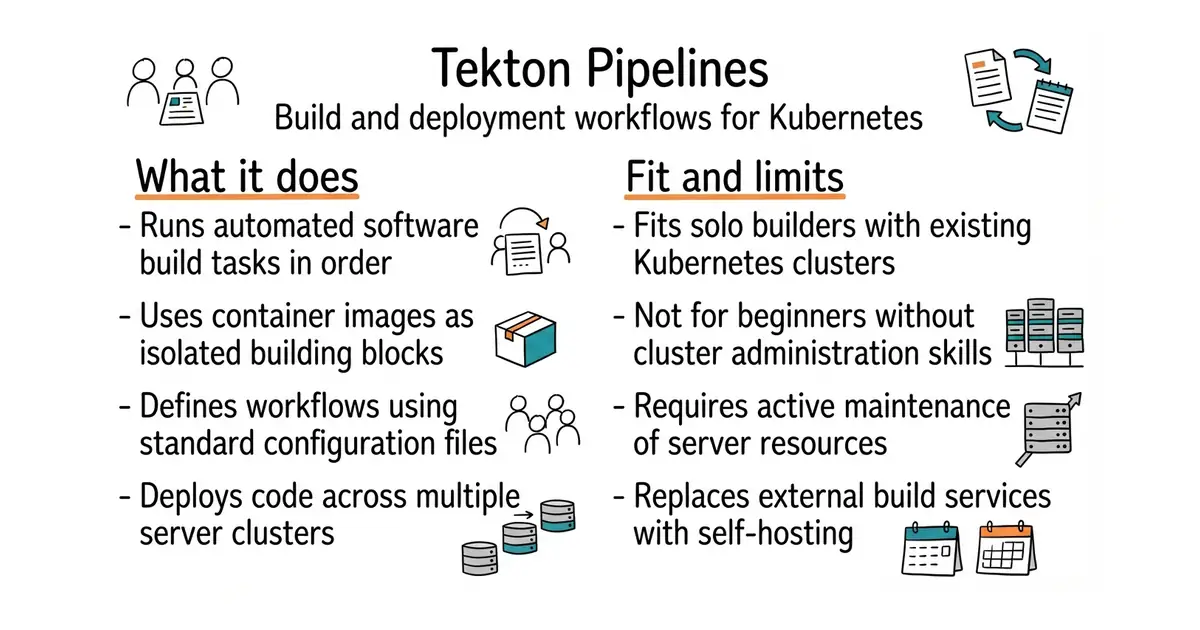
Building software for the web often requires many steps in a strict order. This tool automates those steps so you do not run them by hand. It runs inside Kubernetes (a system for managing programs running across multiple servers). You write files that describe your build steps, and the system executes them inside isolated containers (sealed boxes that keep programs from breaking each other). Setting this up takes a lot of time and requires an existing server cluster.
What it is
Tekton Pipelines provides native Kubernetes resources for defining and running continuous integration and deployment workflows. It uses container images as building blocks to create typed, reusable tasks.
What it is good for
Solo builders who run their own Kubernetes infrastructure and need a modular way to build, test, and deploy code without relying on external services.
- Builds reusable tasks that you can share across multiple projects.
- Runs natively inside Kubernetes without extra external servers.
- Uses standard container images for every step of the build process.
- High setup difficulty for a non-programmer due to complex Kubernetes configuration.
- Needs a running Kubernetes cluster and enough memory to run containerized build steps.
- Requires ongoing maintenance to keep cluster resources and API versions updated.
GitHub Actions
kubectl
- argoproj/argo-workflows17k stars
Runs container workflows on Kubernetes, but uses a different syntax and feature set.
- harness/harness39k stars
Another container-based build system, but usually runs as a simpler standalone server.


- traefik/traefik65k stars
Decides which program answers each incoming request, and builds the rules by watching where the programs are.
- rajnandan1/kener5.2k stars
A status page you run yourself, which checks your services and shows their recent history.
- caprover/caprover15k stars
A web page that installs apps and databases onto one rented computer, and sorts out the addresses and certificates.
kubectl apply --filename https://storage.googleapis.com/tekton-releases/pipeline/latest/release.yaml