8997 stars · MIT (named in the About sidebar, copyright Titus Wormer) · the npm package `remark` has stood at 15.0.1 since September 2023; the repository itself pushed code on 2026-09-01, a three-year gap caused by the ecosystem moving to the smaller packages around it · Track this in Scout
A Markdown processor that lets small plugins inspect and rewrite documents as a tree.
Radar check
What we found when we opened it. Every bar is one fact, with its date.
Last code pushed 27 Sep 2026, 29 days before this check.
Latest release remark-cli@12.0.0 on 18 Sep 2023.
Public since July 2014, a little over 12 years.
9,031 stars and 389 forks.
3 commits and 0 new issues in the last 90 days.
144 contributors. 3 pull requests merged in 90 days.
No security policy file says how to report a problem. No published security advisories.
How the bars are scored
- Alive. Days since the last code push: a week or less 100, a month 90, three months 70, six months 50, a year 30, eighteen months 15, older 0.
- Releases. Age of the latest GitHub release, on a similar scale; no bar when the project publishes no releases.
- Maturity. Age of the project: eight years 100, five 90, three 70, two 55, one 40, six months 25, younger 10.
- Adoption. Stars on a log scale: 100,000 stars is 100, 10,000 is 80, 1,000 is 60, 100 is 40.
- Activity. Commits in the last 90 days: 300 or more 100, 100 85, 30 65, 10 45, any 25.
- Community. People who have contributed: 100 or more 100, 30 80, 10 60, 5 40, 2 25, one 10.
- Security. A published security policy 80, none 40; published advisories are listed, not scored.
Checked by Repo Radar on 26 Oct 2026 from the repository on GitHub. Covered in Edition 62.
▶Repo detailsthe review · specs · pros & cons · install
What it does
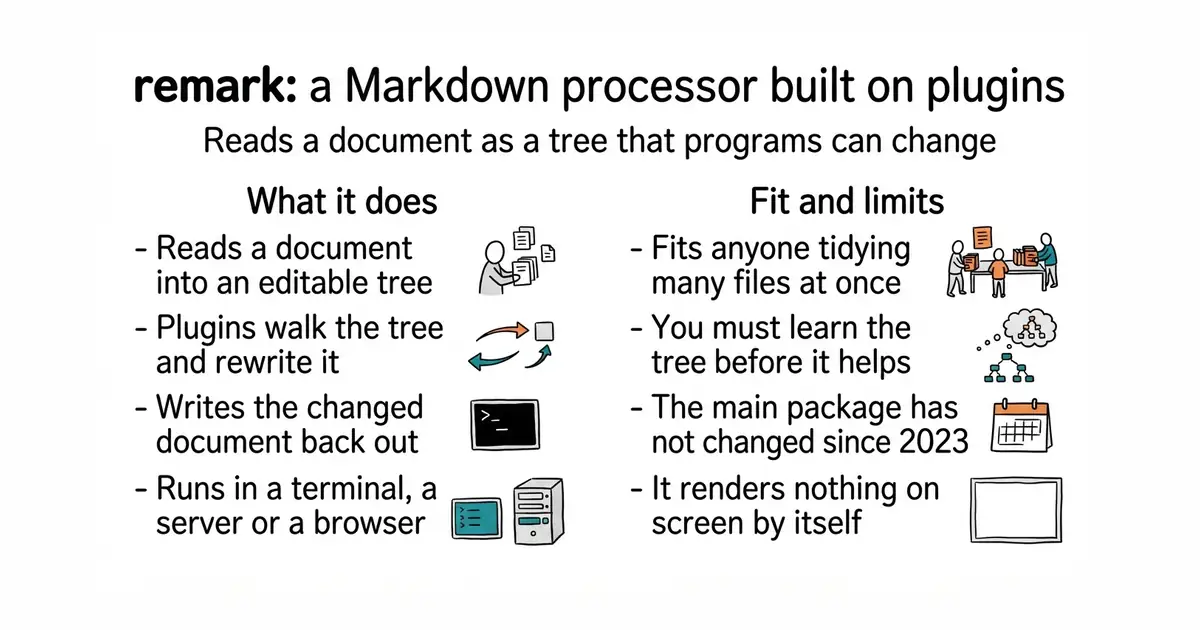
It parses Markdown according to the CommonMark rules and produces a tree that describes the document. Plugins then walk that tree and change it, and the result can be written back out as Markdown or handed to another tool as HTML. The project is one repository holding four pieces: remark-parse for reading, remark-stringify for writing, remark for both together, and remark-cli for running it from a terminal. It runs on a server, in a browser, from the command line and in Deno. It is the engine inside a large part of the JavaScript writing ecosystem, which is why many people already have it without choosing it. It is not an editor, not a site builder and not a renderer — nothing it does puts a page on a screen by itself.
Why it matters
Who it suits. Anyone maintaining more than about fifty Markdown files who keeps finding the same mistake by hand. A rule written once as a plugin fixes every file and keeps fixing them. It also suits anyone who wants to add a new piece of syntax to their own documentation. Skip it if you have ten pages and a text editor, because a search and replace will be quicker than learning a tree shape.
Verdict. Useful, and the learning curve is real. Half a day to understand the tree, then minutes per rule after that. The last code landed on 1 September 2026, so the project is alive, but the published remark package on npm has stood at version 15.0.1 since 2023 — the ecosystem moved to the smaller pieces around it instead. That is a publishing habit, not a sign of trouble, but it does mean the examples you find will not all match. If the job is simply turning Markdown into HTML once, markdown-it/markdown-it is simpler and will do.
- One rule, written once, applies to every file.
- A very large collection of existing plugins to start from.
- Works the same in a terminal, a server and a browser.
- You must learn the document tree before anything useful happens.
- The main package has not had a new version since 2023, so some tutorials are out of date.
- Many small packages to keep track of instead of one.
- markdown-it/markdown-it
21.9k stars, MIT; turns Markdown into HTML quickly and takes plugins, but hands you no document tree to rewrite.
Track this in Scout - micromark/micromark
2.2k stars, MIT; the small strict parser underneath remark, for when you want the parsing and none of the plugin machinery.
Track this in Scout
npm install remark remark-cli remark-preset-lint-recommended
npx remark . --use remark-preset-lint-recommended --frail