10.2k stars · Apache-2.0 · sdk/1.0.0-alpha.20 (2026-09-04) · Track this in Rising ↗
Merchant-of-record checkout for software products — the EU VAT problem legally stops being yours.
Radar check
What we found when we opened it. Every bar is one fact, with its date.
Last code pushed 26 Oct 2026, one day before this check.
Latest release @polar-sh/better-auth@2.1.0 on 6 Oct 2026.
Public since January 2023, a little over 3 years.
10,429 stars and 807 forks.
1,965 commits and 52 new issues in the last 90 days.
134 contributors. 1958 pull requests merged in 90 days.
A security policy says how to report a problem. No published security advisories.
How the bars are scored
- Alive. Days since the last code push: a week or less 100, a month 90, three months 70, six months 50, a year 30, eighteen months 15, older 0.
- Releases. Age of the latest GitHub release, on a similar scale; no bar when the project publishes no releases.
- Maturity. Age of the project: eight years 100, five 90, three 70, two 55, one 40, six months 25, younger 10.
- Adoption. Stars on a log scale: 100,000 stars is 100, 10,000 is 80, 1,000 is 60, 100 is 40.
- Activity. Commits in the last 90 days: 300 or more 100, 100 85, 30 65, 10 45, any 25.
- Community. People who have contributed: 100 or more 100, 30 80, 10 60, 5 40, 2 25, one 10.
- Security. A published security policy 80, none 40; published advisories are listed, not scored.
Checked by Repo Radar on 27 Oct 2026 from the repository on GitHub. Covered in Edition 11.
▶Repo detailsthe review · specs · pros & cons · install
What it does
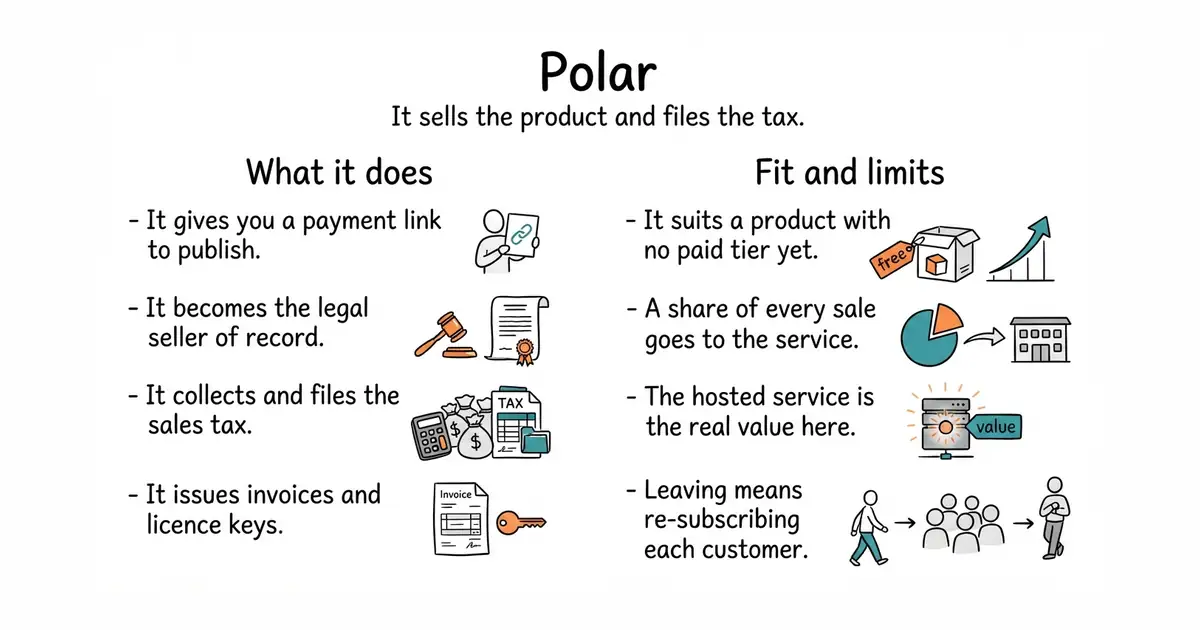
You create a product and a price on the hosted service, and it gives you a payment link to put on a pricing page. Because it is the merchant of record, which means the legally recognised seller, it charges the customer, collects and files European VAT and other sales taxes, issues the invoice, and pays the balance out to you. It provides a customer portal where buyers manage their own subscriptions, licence keys for software that needs activating, usage-based add-ons for charges that vary, and webhooks, which are messages sent to your own server when something happens. There are client libraries for several languages. What it does not do is run on your own hardware in any useful way: the code is published, but the tax registrations and the payouts are the service, and those are not something a self-hosted copy can provide.
Why it matters
Who it suits. Anyone with a finished product and no paid tier, selling to customers in more than one country, who would rather give away a percentage than open tax registrations. It also suits a small team selling a desktop application, because licence keys and the customer portal are included rather than built. Skip it if the product is already selling through an existing payment setup that works, or if a percentage of every sale is unacceptable for the margins involved.
Verdict. The fastest route from no paid tier to a working one, and that speed is the whole recommendation. Two cautions. This is a vendor relationship with a percentage attached, not software you control, and the merchant of record owns the payment relationship, so moving away later means asking every customer to subscribe again somewhere else. The repository releases constantly under per-package tags rather than one version number: the newest, @polar-sh/better-auth 2.1.0, is dated 6 October 2026, which tells you the pace but makes "which version am I on" an awkward question. Read the pricing page before the README.
Summary (Key Points)from the README
Key features
- Flexible pricing models: Usage billing, subscriptions, seats, credits, trials, and discounts can be composed in one product's pricing.
- Precise metering: Tokens, API calls, agent runs, GPU seconds, and storage are billed with precision down to the event.
- Token-based AI billing: Any model can be wrapped with metered token billing on every call.
- Per-run agent billing: Autonomous agents are charged per run with step-level granularity, and retries are not double-billed.
- Compute billing by the second: Fine-tuning, hosted inference, and training runs can be metered by the second.
- Checkout and metrics: Checkouts are designed to convert, and realtime metrics are included.
- Merchant of record: Polar handles receipts, customer accounts, dunning, sales tax, and VAT on the seller's behalf.
- Public API and webhooks: A Public API and Webhook API let you integrate Polar into docs, sites, or services.
- Official SDKs: JavaScript (Node.js and browsers) and Python SDKs are maintained in separate repositories.
Important
- Fees: The Starter plan (free) charges 5.00% + 50¢ per transaction. Pro is 3.80% + 40¢, Growth is 3.60% + 35¢, and Scale is 3.40% + 30¢. The README says additional fees may apply.
- Startup Program: Eligible startups can apply for a year on the most generous plan. The README does not state eligibility criteria.
- Feedback channel: Feature requests and bugs go through the "Feedback" button in the dashboard sidebar, not GitHub issues.
- Security reporting: Vulnerabilities should be reported privately through the project's Security policy.
- Contributing: Local development setup is described in the DEVELOPMENT.md file.
- License: The project is licensed under Apache License 2.0.
Written by an AI model from the project’s README; not part of the review, and it can be wrong.
- The tax and filing burden genuinely transfers, which no self-hosted tool can offer.
- Payment page, customer portal, licence keys and webhooks all work with no server to run.
- Apache-2.0 and releasing constantly, with package tags dated 6 October 2026.
- The value is the hosted service, so this is a vendor you depend on rather than software you own.
- Per-package release tags mean there is no single version number to pin or to report.
- Leaving later means re-subscribing every customer by hand, because the payment relationship is theirs.
Set beside Lago (#1) the division is clean — Polar is how you take money now; Lago is how you meter it later, if and when usage-based pricing is worth building.
Nothing to install.