2.2k stars · AGPL-3.0 · 0.30.3 (2026-09-06) · Track this in Rising ↗
Newsletter tool with built-in signup forms and a visual editor — more marketer-shaped than Listmonk out of the box.
Radar check
What we found when we opened it. Every bar is one fact, with its date.
Last code pushed 27 Oct 2026, one day before this check.
Latest release 0.30.3 on 6 Sep 2026.
Public since January 2021, a little over 5 years.
2,250 stars and 177 forks.
71 commits and 18 new issues in the last 90 days.
39 contributors. 11 pull requests merged in 90 days.
No security policy file says how to report a problem. No published security advisories.
How the bars are scored
- Alive. Days since the last code push: a week or less 100, a month 90, three months 70, six months 50, a year 30, eighteen months 15, older 0.
- Releases. Age of the latest GitHub release, on a similar scale; no bar when the project publishes no releases.
- Maturity. Age of the project: eight years 100, five 90, three 70, two 55, one 40, six months 25, younger 10.
- Adoption. Stars on a log scale: 100,000 stars is 100, 10,000 is 80, 1,000 is 60, 100 is 40.
- Activity. Commits in the last 90 days: 300 or more 100, 100 85, 30 65, 10 45, any 25.
- Community. People who have contributed: 100 or more 100, 30 80, 10 60, 5 40, 2 25, one 10.
- Security. A published security policy 80, none 40; published advisories are listed, not scored.
Checked by Repo Radar on 27 Oct 2026 from the repository on GitHub. Covered in Edition 17.
▶Repo detailsthe review · specs · pros & cons · install
What it does
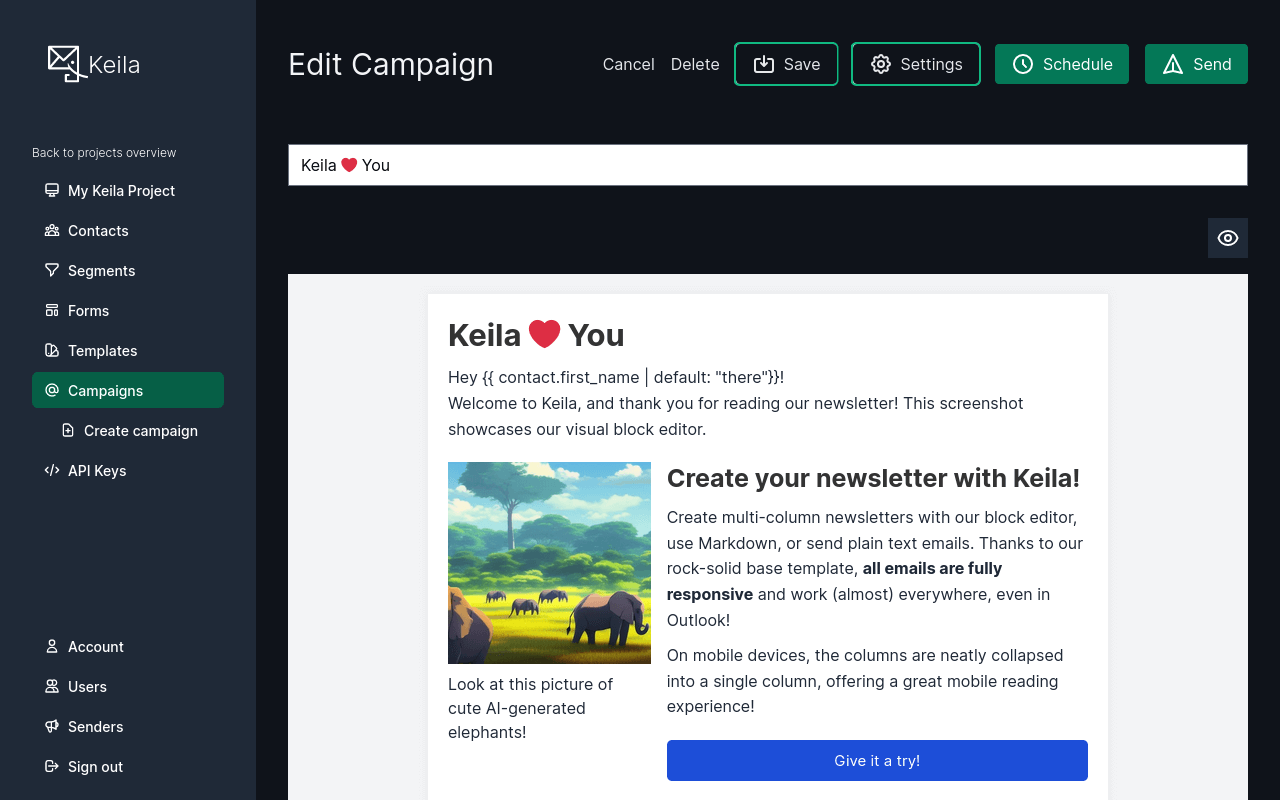
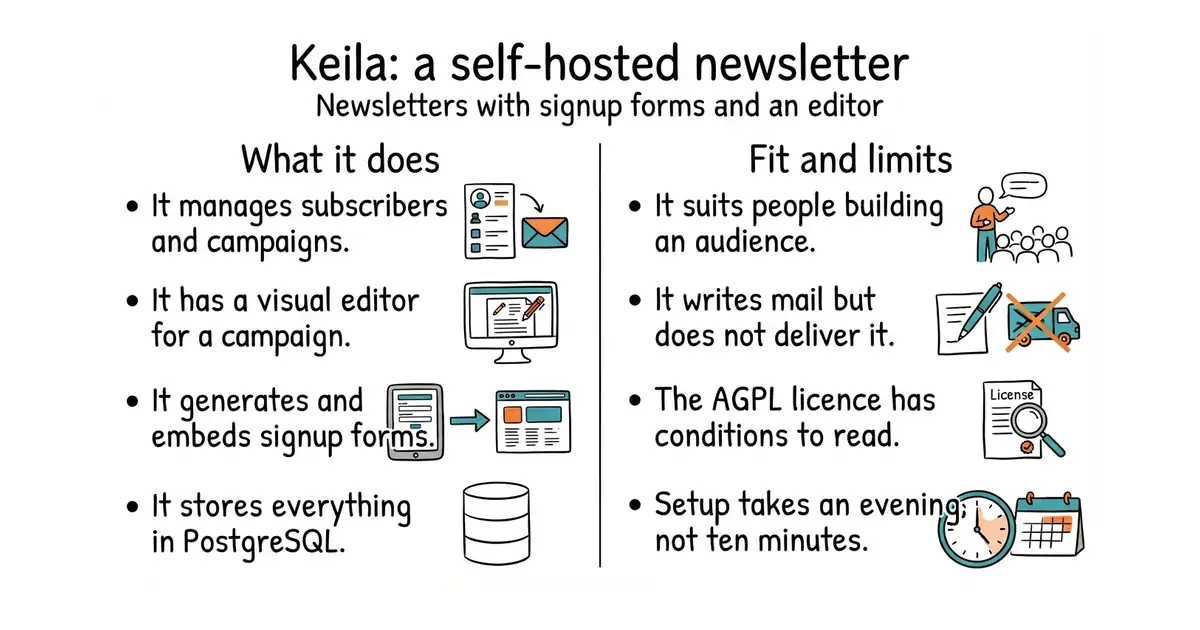
It manages subscribers, signup forms, campaigns, segments and simple statistics. The editor is visual, so a campaign does not have to be written in HTML. Signup forms are generated and embedded, and double opt-in is built in. It is written in Elixir and stores everything in PostgreSQL, which means it runs comfortably on a small machine. Version 0.30.3 was released on 6 September 2026, and code landed on 2 October 2026. It composes and schedules mail, but it does not deliver it: a sending service has to be configured, and that is a separate thing to choose and pay for.
Why it matters
Who it suits. Anybody building an audience who does not want a bill that grows with the list. Paid newsletter services start free and become expensive at exactly the moment a list becomes valuable. It is noticeably more marketer-shaped than plain mailing-list software, because the forms and the visual editor come with it rather than being bolted on. Skip it if the list is under a few hundred people, because a hosted service at that size costs nothing and asks nothing of you.
Verdict. Worth an evening, not ten minutes, and the licence deserves a careful read. AGPL-3.0 means that offering a modified version of Keila to other people as a service obliges you to publish those modifications; running it for one newsletter is completely fine. Pair it with a sending service such as the mail server covered in Edition 15. knadh/listmonk is the main alternative and ships as a single binary, which makes it the easier install when the visual editor is not the point.
Summary (Key Points)from the README
Key features
- Email campaigns: Send out newsletter campaigns from within Keila.
- Sign-up forms: Create forms for people to subscribe to your newsletter.
- Own inbox for small lists: Smaller newsletters can send campaigns through your own email inbox.
- Bulk email providers: Larger projects can use AWS SES, Sendgrid, Mailgun, or Postmark.
- SMTP support: SMTP works alongside the named providers.
- Hosted option: A hosted version of Keila is available at app.keila.io.
- Docker deployment: The official Docker image is pentacent/keila, and the repository includes a sample Docker Compose config.
- Translations and code contributions: The project accepts both, with instructions in CONTRIBUTING.md.
Ways to install
| Platform or method | What it needs | Effort |
|---|---|---|
| Hosted Keila Cloud (app.keila.io) | A Keila Cloud account; pricing is described separately and not given in the README | Not stated in the README |
| Official Docker image (pentacent/keila) | Docker and a server you control | Not stated in the README; the README points to the Installation Docs for details |
| Sample Docker Compose config from the repo | Docker Compose and a server you control | Not stated in the README; the README points to the Installation Docs for details |
Important
- Pricing: The README links to Keila Cloud pricing but does not state the prices.
- Email delivery: Small newsletters can use your own inbox, but larger ones need one of the listed bulk providers or SMTP.
- License: Keila is licensed under the GNU Affero General Public License, version 3 or later, and comes with no warranty.
- Excluded files: The Keila logo and all files in the extra directory are not covered by the license, and the extra directory has its own README.
- Setup detail: Self-hosting details are in the separate Installation Docs, which this README does not cover.
Written by an AI model from the project’s README; not part of the review, and it can be wrong.
- Signup forms and a visual editor come with it, so three tools do not have to be glued together.
- The subscriber list stays on a machine you control.
- It runs well on a small machine, because Elixir is modest with memory.
- AGPL-3.0. Offering a modified version as a service to others means publishing the changes.
- It writes mail but does not deliver it. A separate sending service is still needed.
- Setting it up means Docker, a PostgreSQL database and mail settings. Budget an evening.
# Simplest start, using the project's docker-compose file:
curl -O https://raw.githubusercontent.com/pentacent/keila/main/docker-compose.yml
docker compose up -d
# then open http://localhost:4000 and read https://keila.io/docs