203.7k stars · Sustainable Use License · n8n@2.37.11 (2026-09-07) · Track this in Rising ↗
Visual workflow automation — the hub that wires every other tool on this list into one pipeline.
Radar check
What we found when we opened it. Every bar is one fact, with its date.
Last code pushed 26 Oct 2026, one day before this check.
Latest release n8n@2.44.7 on 26 Oct 2026.
Public since June 2019, a little over 7 years.
208,661 stars and 61,255 forks.
3,976 commits and 789 new issues in the last 90 days.
841 contributors. 4680 pull requests merged in 90 days.
A security policy says how to report a problem. 100 published security advisories.
How the bars are scored
- Alive. Days since the last code push: a week or less 100, a month 90, three months 70, six months 50, a year 30, eighteen months 15, older 0.
- Releases. Age of the latest GitHub release, on a similar scale; no bar when the project publishes no releases.
- Maturity. Age of the project: eight years 100, five 90, three 70, two 55, one 40, six months 25, younger 10.
- Adoption. Stars on a log scale: 100,000 stars is 100, 10,000 is 80, 1,000 is 60, 100 is 40.
- Activity. Commits in the last 90 days: 300 or more 100, 100 85, 30 65, 10 45, any 25.
- Community. People who have contributed: 100 or more 100, 30 80, 10 60, 5 40, 2 25, one 10.
- Security. A published security policy 80, none 40; published advisories are listed, not scored.
Checked by Repo Radar on 26 Oct 2026 from the repository on GitHub. Covered in Edition 1.
▶Repo detailsthe review · specs · pros & cons · install
What it does
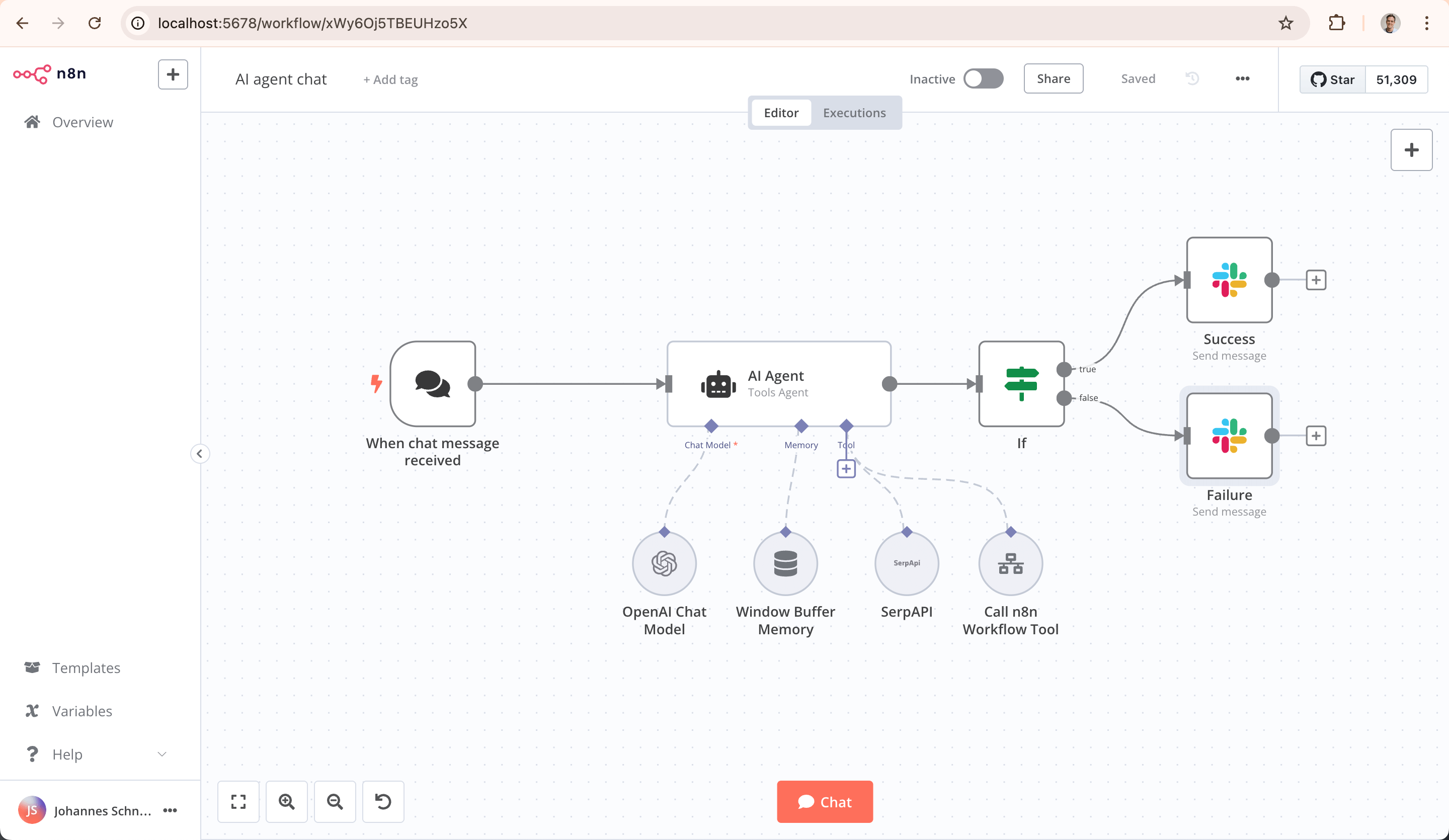
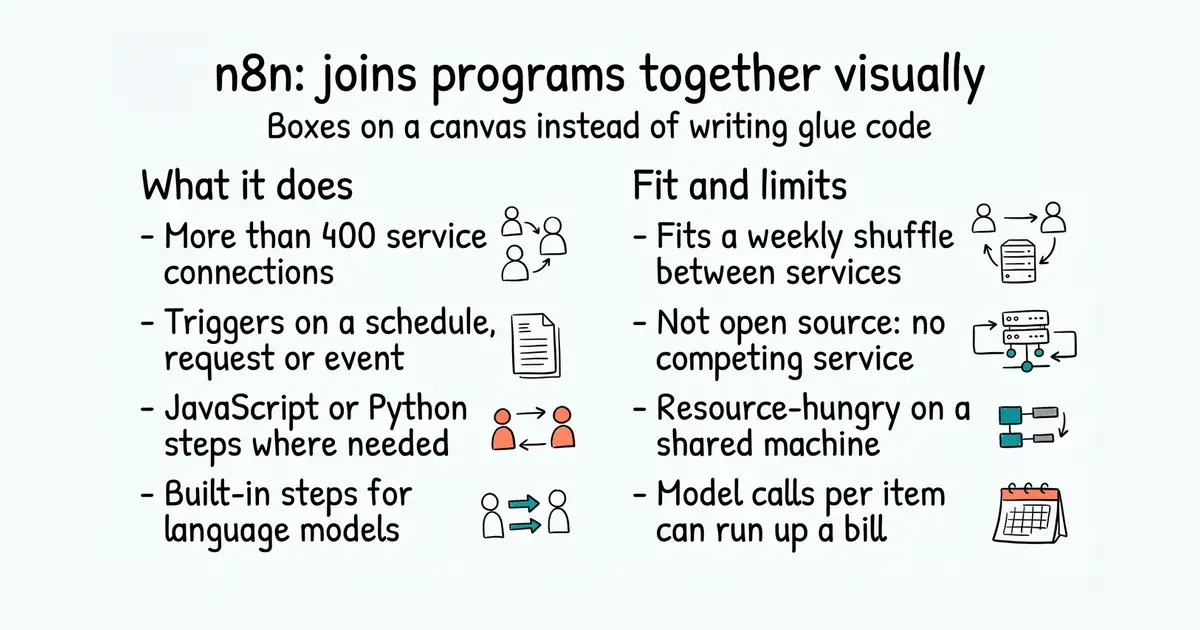
A workflow is built by placing nodes on a canvas: a trigger that starts it, then steps that fetch, transform and send information. More than 400 services are supported, and any service with a web interface can be reached with a generic request node. Steps can include JavaScript or Python when dragging boxes is not enough. It has built-in steps for talking to language models, and it can act as a server or client for the Model Context Protocol, which is a standard way for assistants to use external tools. It runs on a schedule, on a web request, or on an event from a connected service. What it does not do is come under an open-source licence: the main code is under the Sustainable Use License, which permits internal business use and forbids reselling it as a service, with separate enterprise terms for some features.
Why it matters
Who it suits. Anyone whose work involves the same five-step shuffle every week between services that do not talk to each other. The visual canvas is the real benefit: a chain you can see is a chain you can debug without being a programmer. It also suits a team that wants fixed costs, because self-hosting means volume does not change the bill. Skip it if you want to resell the automation as a product, because the licence forbids that. Skip it too if one scheduled script would do, because this is a service to keep running.
Verdict. Worth an evening, and it is the piece that makes the other tools in this edition into one chain rather than eight separate things. At 206,885 stars it is by a wide margin the largest repository in this edition, release 2.42.6 landed on 9 October 2026 and code on 8 October 2026. Three things to be clear about. The licence is not open source, and the distinction is practical rather than academic: internal use is fine, selling a hosted copy is not. It is resource-hungry, so a busy instance competes for memory with everything else on the same machine. And workflows that call a language model on every item can quietly run up a bill at the model provider, so put a limit on the loop before you leave it running. If the licence is the problem, activepieces/activepieces is MIT licensed for its community edition.
Summary (Key Points)from the README
Key features
- AI-native automation: Build and run AI workflows and multi-step agents using your own data, models, and tools.
- Model flexibility: Connect OpenAI, Anthropic, Google, or open-source models and switch providers without changing your architecture.
- Prototype to production: Design multi-step workflows with logic, tool use, human approvals, and full observability.
- Code when needed: Combine visual building with JavaScript, Python, and npm packages.
- Enterprise controls: Self-host or deploy securely with role-based access, audit trails, and support for sensitive data.
- Large integration library: Connect to 1500+ integrations and 9,000+ workflow templates.
- Self-hostable: Deploy anywhere, with source code always visible.
- Extensible: Add your own nodes and functionality.
Ways to install
| Platform or method | What it needs | Effort |
|---|---|---|
| Install script | Docker | One command (per the Quick Start) |
| Manual Docker deployment | Docker | Not stated in the README |
Important
- Docker dependency: The quick-start install script requires Docker.
- Fair-code license: n8n is distributed under the Sustainable Use License and the n8n Enterprise License, not an open-source license. Read the licensing docs before commercial use.
- Paid tier for extras: Additional features and support are available through Enterprise Licenses; the README gives no prices.
- Support channel: The README points to the community forum as the place to get help.
Written by an AI model from the project’s README; not part of the review, and it can be wrong.
- Visual, so a workflow is buildable and, more to the point, fixable without being a programmer.
- More than 400 connections, plus a generic request step for anything not on the list.
- Fixed cost on a machine of your own regardless of how many times a workflow runs.
- Not open source. The Sustainable Use License forbids offering it as a competing service.
- Resource-hungry, and a busy instance competes for memory with everything else on the machine.
- Easy to start and fiddly to debug once workflows get long, and a step that calls a language model on every item can run up a real bill.
# The install script
curl -fsSL https://get.n8n.io | sh
# Or manually
docker volume create n8n_data
docker run -it --rm --name n8n -p 5678:5678 \
  -v n8n_data:/home/node/.n8n docker.n8n.io/n8nio/n8n