1.6k stars · MIT · v6.1.3 (2026-09-07) · Track this in Rising ↗
Write email in utility classes; it compiles to the inlined table markup Outlook still requires.
Radar check
What we found when we opened it. Every bar is one fact, with its date.
Last code pushed 25 Oct 2026, 2 days before this check.
Latest release v6.3.0 on 21 Oct 2026.
Public since December 2018, a little over 7 years.
1,620 stars and 69 forks.
274 commits and 9 new issues in the last 90 days.
22 contributors. 111 pull requests merged in 90 days.
No security policy file says how to report a problem. No published security advisories.
How the bars are scored
- Alive. Days since the last code push: a week or less 100, a month 90, three months 70, six months 50, a year 30, eighteen months 15, older 0.
- Releases. Age of the latest GitHub release, on a similar scale; no bar when the project publishes no releases.
- Maturity. Age of the project: eight years 100, five 90, three 70, two 55, one 40, six months 25, younger 10.
- Adoption. Stars on a log scale: 100,000 stars is 100, 10,000 is 80, 1,000 is 60, 100 is 40.
- Activity. Commits in the last 90 days: 300 or more 100, 100 85, 30 65, 10 45, any 25.
- Community. People who have contributed: 100 or more 100, 30 80, 10 60, 5 40, 2 25, one 10.
- Security. A published security policy 80, none 40; published advisories are listed, not scored.
Checked by Repo Radar on 26 Oct 2026 from the repository on GitHub. Covered in Edition 11.
▶Repo detailsthe review · specs · pros & cons · install
What it does
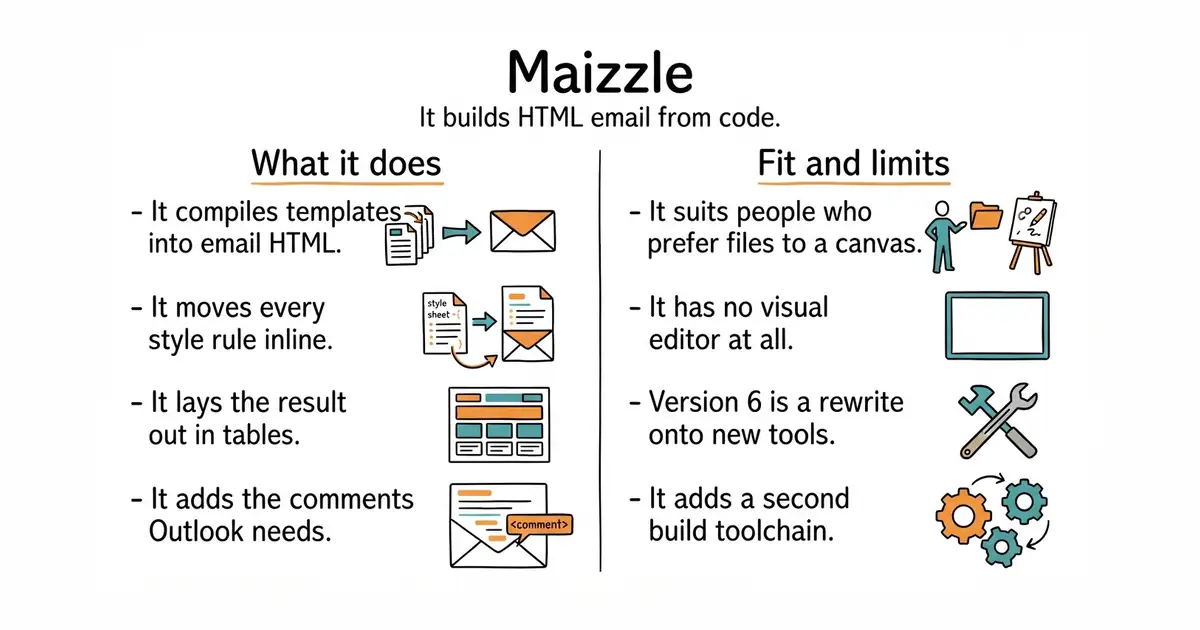
Version 6 is built on Vite, a modern build tool, and lets you write email templates with Vue components and Tailwind CSS, which is a styling system of small single-purpose classes. You write components and reuse them. The build step then does the unpleasant part: it moves styles inline, because several mail programs ignore a stylesheet, lays the result out in tables, and adds the conditional comments that Outlook needs. The output is a set of HTML files ready to hand to whatever sends the mail. Because the input is text, a five-message onboarding sequence is a folder of files, so a coding assistant can draft it and version control keeps every revision. A translated edition of the same sequence is the same templates with a different strings file. What it does not provide is any visual editor: there is nothing to drag, and nothing to click.
Why it matters
Who it suits. Anyone sending transactional or campaign email who already works in code and would rather review a diff than a canvas. It pairs with any sending tool that expects HTML to be supplied. It also suits bilingual sending, because the second language is a strings file rather than five rebuilt messages. Skip it if the person writing the emails is not a programmer, because a visual builder will serve them far better.
Verdict. A small, focused tool that solves the genuinely hard part of email, and the smallest project in this edition at 1,596 stars. Two things to know. Version 6 is a different tool from version 5: the move to Vite, Vue and Tailwind means older guides and older projects do not carry across, and the newest release, 6.2.1, is dated 11 October 2026. And it adds a second build toolchain beside whatever builds the website, which is one more thing to keep working. mjmlio/mjml is the older and better-known alternative with its own markup language, and resend/react-email is the React-shaped equivalent.
Summary (Key Points)from the README
Key features
- Vite-powered build: Maizzle is built on Vite, the README's stated foundation for the framework.
- Vue templates: Emails are written with Vue, as the README describes.
- Tailwind CSS styling: Styling uses Tailwind CSS, per the README's description.
- HTML email focus: The framework is aimed at building HTML emails specifically.
- Official documentation: The README points to separate Maizzle documentation for usage details.
- Starter project: A separate Starter repository is the recommended starting point for building emails.
- MIT license: The framework is open-source under the MIT license, so it can be used and modified under those terms.
Important
- Core code only: This repository holds the framework's core code, not a ready-to-use email project. Use the Starter repository to begin building emails.
- Requirements not listed: The README does not state system requirements, supported Node.js versions or setup steps, so check the documentation before installing.
Written by an AI model from the project’s README; not part of the review, and it can be wrong.
- Text in and HTML out, so emails can be drafted in an editor and tracked in version control.
- It solves the hard part: inlining styles, table layout and Outlook's conditional comments.
- MIT, small, and actively released, with 6.2.1 dated 11 October 2026.
- Version 6 is a rewrite onto Vite, Vue and Tailwind, so older guides and projects do not transfer.
- A second build toolchain to maintain beside the one that builds the site.
- No visual editor at all, which rules it out for anyone who is not comfortable in code.
npx maizzle new