Radar check
What we found when we opened it. Every bar is one fact, with its date.
Last code pushed 25 Oct 2026, one day before this check.
No releases published on GitHub; the code date above is the one to trust.
Public since May 2015, a little over 11 years.
2,023 stars and 256 forks.
40 commits and 9 new issues in the last 90 days.
747 contributors. 3 pull requests merged in 90 days.
A security policy says how to report a problem. No published security advisories.
How the bars are scored
- Alive. Days since the last code push: a week or less 100, a month 90, three months 70, six months 50, a year 30, eighteen months 15, older 0.
- Releases. Age of the latest GitHub release, on a similar scale; no bar when the project publishes no releases.
- Maturity. Age of the project: eight years 100, five 90, three 70, two 55, one 40, six months 25, younger 10.
- Adoption. Stars on a log scale: 100,000 stars is 100, 10,000 is 80, 1,000 is 60, 100 is 40.
- Activity. Commits in the last 90 days: 300 or more 100, 100 85, 30 65, 10 45, any 25.
- Community. People who have contributed: 100 or more 100, 30 80, 10 60, 5 40, 2 25, one 10.
- Security. A published security policy 80, none 40; published advisories are listed, not scored.
Checked by Repo Radar on 26 Oct 2026 from the repository on GitHub.
In simple English
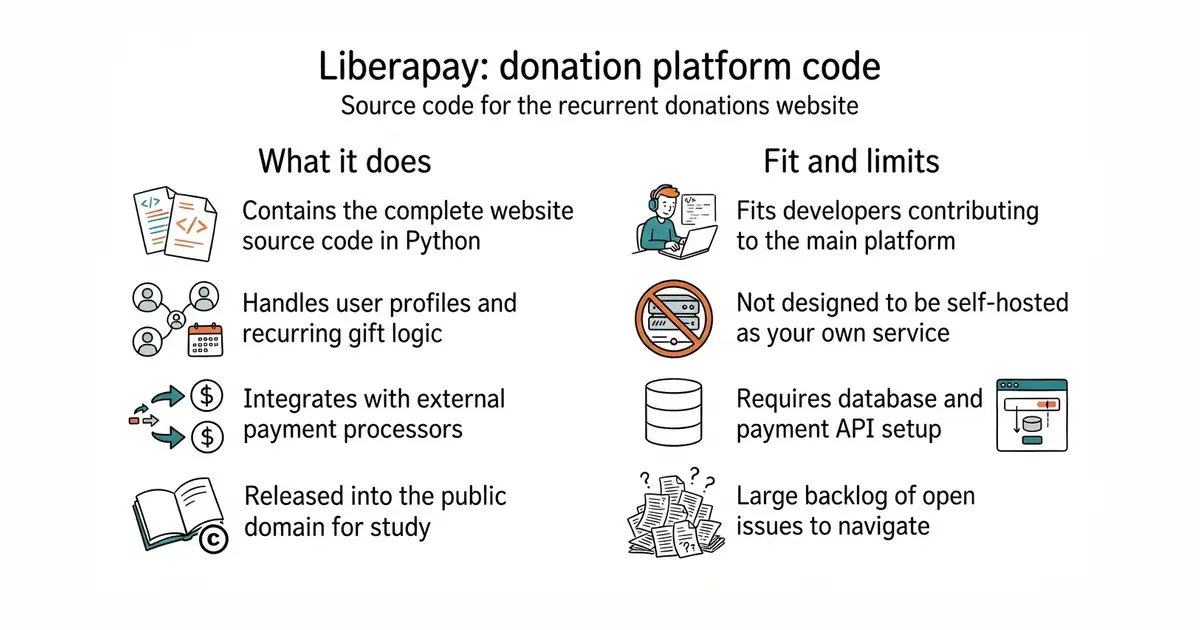
Liberapay is a website for collecting regular donations from people who like your work. This repository contains the source code for that website. You can study how it works or adapt it for your own projects. It cannot be run as your own independent copy of the main service. The project is free to use and inspect.
What it is
This repository holds the Python (a programming language used to build websites and handle server tasks) web application code for Liberapay. It includes all the pages, database queries, and payment integration logic.
What it is good for
This is good for developers who want to contribute code to the Liberapay platform or study how a donation website handles money transfers. It is not a tool you can install on your own server to run a private donation service.
- Fully open source code under a public domain dedication, so you can reuse any part of it.
- Built with Python, making it easy for many web developers to read and modify.
- Active community and history of handling real-world recurring payments.
- Cannot be self-hosted as a drop-in replacement for the main Liberapay service.
- High number of open issues indicates a large backlog of unaddressed bugs and feature requests.
- Setting up the full development environment requires configuring databases and payment provider sandboxes.
Writing a custom donation platform from scratch
PostgreSQL (a powerful open-source database system used to store user accounts and transaction records)
- opencollective/opencollective-frontend897 stars
Open Collective provides another platform for transparent crowdfunding and recurring donations.
- btcpayserver/btcpayserver7.9k stars
BTCPay Server lets you self-host a payment processor for receiving direct donations without middlemen.


- btcpayserver/btcpayserver7.8k stars
Payment software you run yourself that takes Bitcoin into a wallet whose keys you hold.
- hledgerorg/hledger4.8k stars
Double-entry accounting over plain text files, with command-line, terminal, web and editor interfaces.
- akaunting/akaunting10k stars
Self-hosted invoicing and expense tracking, with the double-entry accounting sold separately as an add-on.
git clone https://github.com/liberapay/liberapay.com.git
cd liberapay.com
pip install -r requirements.txt