Radar check
What we found when we opened it. Every bar is one fact, with its date.
Last code pushed 21 Sep 2026, 34 days before this check.
Latest release 1.0.4 on 19 Apr 2025.
Public since January 2016, a little over 10 years.
50,039 stars and 3,865 forks.
1 commits and 9 new issues in the last 90 days.
430 contributors. No pull requests merged in 90 days; changes go in directly.
No security policy file says how to report a problem. No published security advisories.
How the bars are scored
- Alive. Days since the last code push: a week or less 100, a month 90, three months 70, six months 50, a year 30, eighteen months 15, older 0.
- Releases. Age of the latest GitHub release, on a similar scale; no bar when the project publishes no releases.
- Maturity. Age of the project: eight years 100, five 90, three 70, two 55, one 40, six months 25, younger 10.
- Adoption. Stars on a log scale: 100,000 stars is 100, 10,000 is 80, 1,000 is 60, 100 is 40.
- Activity. Commits in the last 90 days: 300 or more 100, 100 85, 30 65, 10 45, any 25.
- Community. People who have contributed: 100 or more 100, 30 80, 10 60, 5 40, 2 25, one 10.
- Security. A published security policy 80, none 40; published advisories are listed, not scored.
Checked by Repo Radar on 26 Oct 2026 from the repository on GitHub.
In simple English
Bulma is a ready-made style sheet that gives your website clean buttons, boxes, and menus without needing any JavaScript. You add class names to your HTML code, and your page instantly looks modern and neat. It costs nothing to use, and you do not need to run a server to make it work. Your users will see a fast-loading page because the file is small and light. You only need to know basic HTML to get started.
What it is
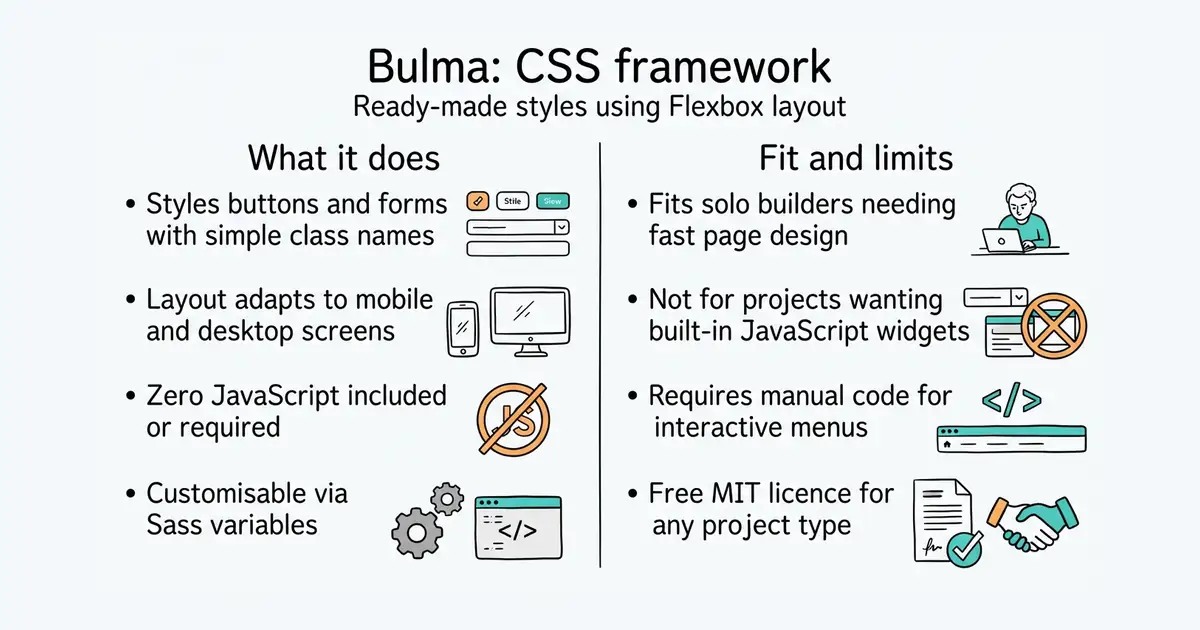
Bulma is a modern CSS (a way to style the look and layout of web pages) framework based on Flexbox (a layout method that lets items stretch and fit different screen sizes automatically). It provides ready-made design elements that you can drop into any web project.
What it is good for
This is good for solo builders who want a professional website design quickly without writing design rules from scratch. It saves you from styling every button, form, and navigation bar by hand.
- Zero JavaScript means it will not conflict with your own scripts or slow down your page.
- Ready-made classes let you build responsive layouts that look good on phones and large screens.
- Free to use under an MIT licence for any personal or commercial project.
- You must write your own JavaScript logic for interactive parts like dropdowns and modals.
- Customising colours requires setting up Sass (a language that adds special features to CSS) and recompiling the files.
- Class names can become long and numerous in your HTML files as your page grows.
Writing custom CSS layout rules from scratch
Plain HTML templates
- twbs/bootstrap175k stars
The most popular CSS framework, but it includes JavaScript plugins alongside styles.
- tailwindlabs/tailwindcss98k stars
A utility-first CSS framework that lets you style elements with small atomic classes instead of pre-built components.


- iconoir-icons/iconoir4.6k stars
1,671 hand-drawn icons, free for any use, packaged nine different ways.
- libvips/libvips12k stars
Resizes and converts images several times faster and with far less memory than the usual tool.
- ImageMagick/ImageMagick18k stars
Converts, resizes and edits images from one typed command, across more than two hundred formats.
npm install bulma