Radar check
What we found when we opened it. Every bar is one fact, with its date.
Last code pushed 26 Oct 2026, the same day before this check.
Latest release jenkins-2.587 on 20 Oct 2026.
Public since November 2010, a little over 15 years.
26,693 stars and 9,809 forks.
278 commits and 78 new issues in the last 90 days.
1,223 contributors. 238 pull requests merged in 90 days.
A security policy says how to report a problem. No published security advisories.
How the bars are scored
- Alive. Days since the last code push: a week or less 100, a month 90, three months 70, six months 50, a year 30, eighteen months 15, older 0.
- Releases. Age of the latest GitHub release, on a similar scale; no bar when the project publishes no releases.
- Maturity. Age of the project: eight years 100, five 90, three 70, two 55, one 40, six months 25, younger 10.
- Adoption. Stars on a log scale: 100,000 stars is 100, 10,000 is 80, 1,000 is 60, 100 is 40.
- Activity. Commits in the last 90 days: 300 or more 100, 100 85, 30 65, 10 45, any 25.
- Community. People who have contributed: 100 or more 100, 30 80, 10 60, 5 40, 2 25, one 10.
- Security. A published security policy 80, none 40; published advisories are listed, not scored.
Checked by Repo Radar on 26 Oct 2026 from the repository on GitHub.
In simple English
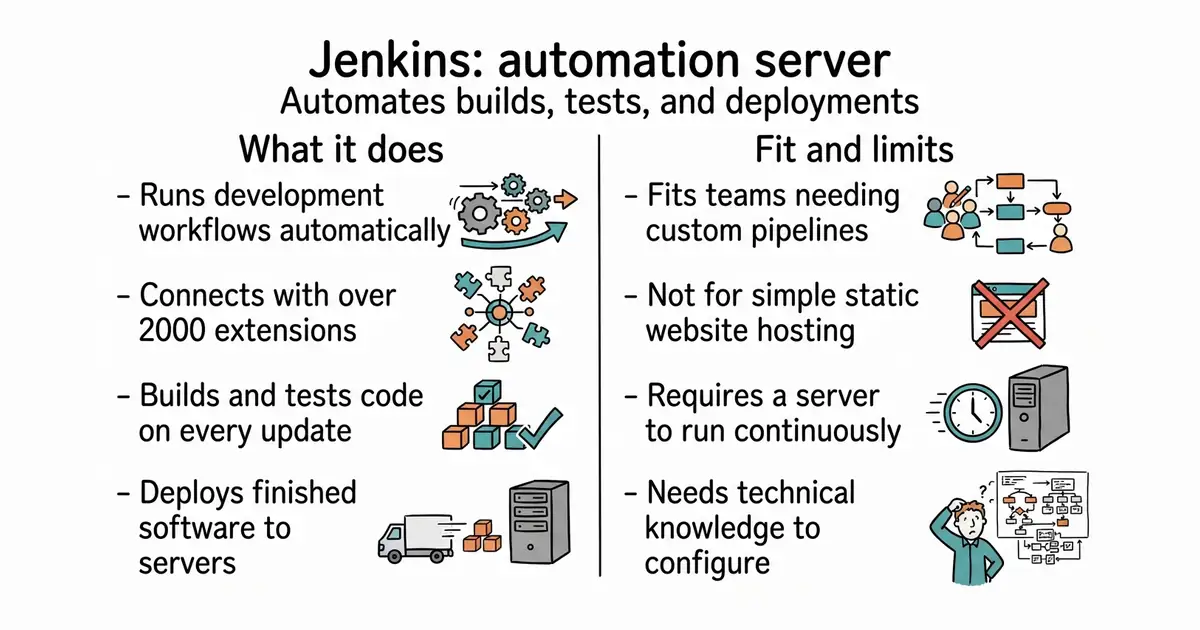
Jenkins is a server application that handles repetitive tasks for you. It runs your tests, builds your code, and pushes updates to your production servers. You set up rules for when these tasks should run. It saves you from doing those chores by hand every time you change your code. It is free to use, but you need a server to host it and some time to configure it.
What it is
Jenkins is an open-source automation server built in Java (a popular programming language used to run software on servers and computers) that coordinates software builds, tests, and deployments. It connects to your source code repository (a storage place where your project's files and history live) and triggers workflows whenever new code is added.
What it is good for
Solo builders who want to automatically test their code and deploy updates to their servers without clicking buttons manually.
- Over 2,000 plugins available to connect with almost any external tool or service.
- Supports both frequent weekly updates and stable long-term support releases.
- Free and open-source under the MIT licence (a simple set of rules letting you use, change, and share the software freely).
- Difficult setup and configuration for non-programmers.
- Requires a dedicated server with enough RAM (random access memory, the active workspace your computer or server uses to run programs) to stay online.
- Maintenance can become heavy as your plugin list and pipeline definitions grow.
manual software deployments and running tests by hand
Git for tracking changes in your code
- actions/runner6.4k stars
GitHub Actions runner executes CI/CD workflows directly inside your GitHub repositories without requiring a separate server.
- harness/harness39k stars
Drone is a container-based continuous delivery system that runs your automation pipelines inside isolated boxes.


- traefik/traefik65k stars
Decides which program answers each incoming request, and builds the rules by watching where the programs are.
- rajnandan1/kener5.2k stars
A status page you run yourself, which checks your services and shows their recent history.
- caprover/caprover15k stars
A web page that installs apps and databases onto one rented computer, and sorts out the addresses and certificates.
Download the official WAR file, Docker container (a way to run a program inside its own sealed box, so it cannot break anything else on your server), or native package from the Jenkins website.