Radar check
What we found when we opened it. Every bar is one fact, with its date.
Last code pushed 25 Oct 2026, the same day before this check.
Latest release v0.8.0 on 25 Oct 2026.
Public since October 2026, 1 months.
291 stars and 19 forks.
245 commits and 3 new issues in the last 90 days.
1 contributor. No pull requests merged in 90 days; changes go in directly. A small team carries it.
No security policy file says how to report a problem. No published security advisories.
How the bars are scored
- Alive. Days since the last code push: a week or less 100, a month 90, three months 70, six months 50, a year 30, eighteen months 15, older 0.
- Releases. Age of the latest GitHub release, on a similar scale; no bar when the project publishes no releases.
- Maturity. Age of the project: eight years 100, five 90, three 70, two 55, one 40, six months 25, younger 10.
- Adoption. Stars on a log scale: 100,000 stars is 100, 10,000 is 80, 1,000 is 60, 100 is 40.
- Activity. Commits in the last 90 days: 300 or more 100, 100 85, 30 65, 10 45, any 25.
- Community. People who have contributed: 100 or more 100, 30 80, 10 60, 5 40, 2 25, one 10.
- Security. A published security policy 80, none 40; published advisories are listed, not scored.
Checked by Repo Radar on 26 Oct 2026 from the repository on GitHub.
In simple English
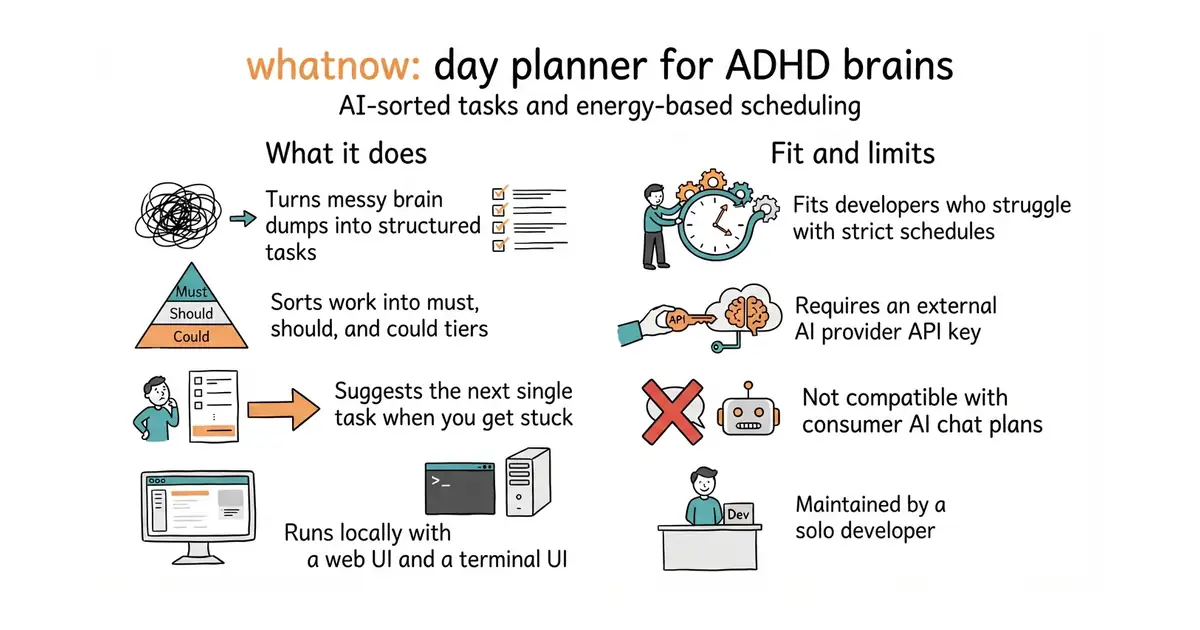
This is a daily planner designed for people with ADHD. You write down everything on your mind in a messy brain dump. An artificial intelligence model reads your notes and splits them into must-do, should-do, and could-do lists. It checks your energy level and plans your day around when you feel tired or focused. If you get stuck, you can ask it what to do next right now.
What it is
A local day planner written in the Go programming language (a compiled language for building fast software), featuring both a web interface and a terminal interface (a text-only screen for your computer's command line). It stores all your tasks locally in a SQLite database (a self-contained file database stored directly on your computer) while requiring your own external AI model API key (a secret password that lets your app talk to a paid AI service) to function.
What it is good for
Solo builders and developers who struggle with standard hourly schedules and want an AI assistant to organize their messy task lists and calendar events based on their daily energy.
- Runs entirely on your machine with your data stored locally in SQLite.
- Offers both a web interface and a terminal interface that stay in sync.
- Pulls meetings from calendar links and imports tickets from Jira or GitHub.
- Requires an external API key from a paid AI provider like Anthropic or OpenAI.
- Consumer AI subscriptions like Claude Pro or ChatGPT Plus do not work with it.
- Requires Go and Node.js if you want to build and run it from the source code.
Traditional hourly calendars and manual daily to-do lists
Tailscale
- usememos/memos64k stars
A lightweight note-taking service for capturing quick thoughts, though it lacks an automated daily planning ritual.

brew install jameynakama/tap/whatnow