4.8k stars · MIT · v0.18.0 (2026-06-29) · Track this in Rising ↗
One command Lighthouse-scans every page of a site and ranks what to fix. npx, nothing to host.
Radar check
What we found when we opened it. Every bar is one fact, with its date.
Last code pushed 23 Oct 2026, 4 days before this check.
Latest release v0.19.1 on 3 Oct 2026.
Public since October 2021, a little over 4 years.
4,914 stars and 180 forks.
30 commits and 19 new issues in the last 90 days.
30 contributors. 43 pull requests merged in 90 days.
No security policy file says how to report a problem. No published security advisories.
How the bars are scored
- Alive. Days since the last code push: a week or less 100, a month 90, three months 70, six months 50, a year 30, eighteen months 15, older 0.
- Releases. Age of the latest GitHub release, on a similar scale; no bar when the project publishes no releases.
- Maturity. Age of the project: eight years 100, five 90, three 70, two 55, one 40, six months 25, younger 10.
- Adoption. Stars on a log scale: 100,000 stars is 100, 10,000 is 80, 1,000 is 60, 100 is 40.
- Activity. Commits in the last 90 days: 300 or more 100, 100 85, 30 65, 10 45, any 25.
- Community. People who have contributed: 100 or more 100, 30 80, 10 60, 5 40, 2 25, one 10.
- Security. A published security policy 80, none 40; published advisories are listed, not scored.
Checked by Repo Radar on 26 Oct 2026 from the repository on GitHub. Covered in Edition 2.
▶Repo detailsthe review · specs · pros & cons · install
What it does
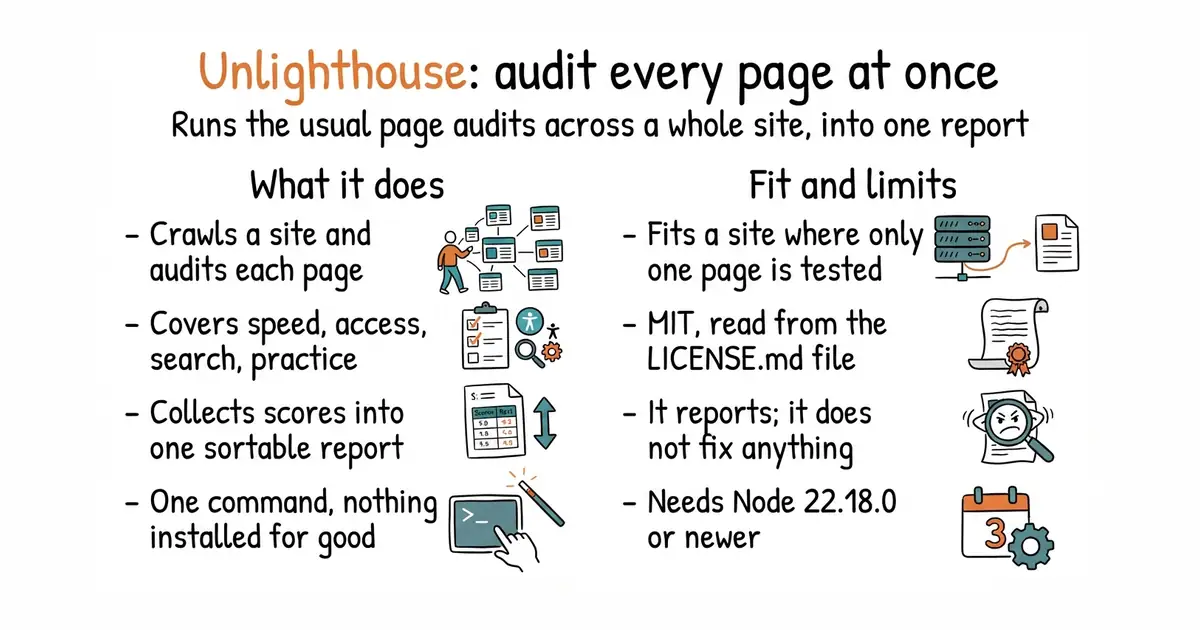
It crawls a site, runs the same audits on each page it finds, and shows the results in a single screen that can be sorted. The audits cover performance, accessibility, search readiness and best practice, which are the categories the underlying tool reports. It samples rather than auditing every page blindly, which is what the project means by smart sampling. Reports are written into an output folder, and the README recommends adding that folder to the list of files version control ignores. There is a --debug flag for when a crawl goes wrong. It needs Node 22.18.0 or newer, a figure it states explicitly. What it does not do is say anything about its own limits: the README carries no list of unsupported cases and no warning about how much processor time a large site will take.
Why it matters
Who it suits. Anyone running a site of more than a handful of pages who has only ever tested the home page. The pages that most need to rank are usually not the ones anybody tests, and this finds them. It produces a concrete list rather than a verdict, which is exactly the kind of work that can be handed to somebody else. Skip it if the site is a single page, and skip it if there is no intention of acting on the list, because a score is not revenue.
Verdict. Worth five minutes, and the single command with nothing installed afterwards makes the trial free of any decision. It is in good order: MIT, read from the LICENSE.md file, copyright 2016 to the present, Harlan Wilton, with release v0.19.1 on 3 October 2026 and code on 4 October 2026. Three honest limits. It reports and does not fix, and some of what it reports is real work. The crawl itself is heavy on the processor, so it belongs on a laptop rather than on the machine serving the site, and the README does not warn about that at all. And the Node floor of 22.18.0 is specific enough to be a problem on an older machine. If the whole-site view is less interesting than repeatable monitoring over time, sitespeedio/sitespeed.io is the better fit.
Summary (Key Points)from the README
Key features
- Whole-site scanning: Scans your entire site using Google Lighthouse.
- Modern UI: Presents the scan results in a modern user interface.
- Minimal config: Designed to work with little configuration.
- Smart sampling: Uses smart sampling to limit which pages are audited.
- Saved reports: Writes reports to a configurable `outputDir`.
- Docs and demo: Integration instructions, guides, API and config spec are on the docs site, and a live demo is available.
- AI agent skill: An unlighthouse Skill is available for AI agents at skilld.dev.
- Community help: A Discord server offers one-on-one help.
Important
- Node version: Requires Node 22.18.0 or newer.
- Install steps elsewhere: The README does not list integrations or install steps in detail; those are on the docs site.
- Report files: Reports are saved to `outputDir`, and the README recommends adding them to `.gitignore`.
- Troubleshooting: If something goes wrong, the README's first suggested step is to re-run the scan with debugging enabled.
Written by an AI model from the project’s README; not part of the review, and it can be wrong.
- One command through
npx, with nothing installed permanently and no account to create. - It covers the whole site, which is the difference from the single-page tools everybody already uses.
- MIT, read from the file, with release v0.19.1 on 3 October 2026 and code the following day.
- It reports, it does not fix, and the README offers no statement of what it will not handle.
- Crawling a large site is heavy on the processor, and nothing in the documentation warns about that.
- Node 22.18.0 or newer is required, which rules out a machine that has not been updated recently.
Grasppy is a heavy React app, and heavy React apps quietly fail the Core Web Vitals that Google feeds into ranking — usually on the exact marketing pages that most need to rank.
npx unlighthouse --site example.com
# Or with pnpm
pnpm dlx unlighthouse --site example.com
# When a crawl goes wrong
npx unlighthouse --site example.com --debug