24.7k stars · AGPL-3.0 open-core + commercial EE · no tagged releases; 26,053 commits on main · Track this in Rising ↗
Branded short links with click-to-signup conversion tracking — turns 'did that video work?' into a number.
Radar check
What we found when we opened it. Every bar is one fact, with its date.
Last code pushed 25 Oct 2026, 2 days before this check.
No releases published on GitHub; the code date above is the one to trust.
Public since August 2022, a little over 4 years.
24,945 stars and 3,341 forks.
2,668 commits and 31 new issues in the last 90 days.
94 contributors. 439 pull requests merged in 90 days.
A security policy says how to report a problem. No published security advisories.
How the bars are scored
- Alive. Days since the last code push: a week or less 100, a month 90, three months 70, six months 50, a year 30, eighteen months 15, older 0.
- Releases. Age of the latest GitHub release, on a similar scale; no bar when the project publishes no releases.
- Maturity. Age of the project: eight years 100, five 90, three 70, two 55, one 40, six months 25, younger 10.
- Adoption. Stars on a log scale: 100,000 stars is 100, 10,000 is 80, 1,000 is 60, 100 is 40.
- Activity. Commits in the last 90 days: 300 or more 100, 100 85, 30 65, 10 45, any 25.
- Community. People who have contributed: 100 or more 100, 30 80, 10 60, 5 40, 2 25, one 10.
- Security. A published security policy 80, none 40; published advisories are listed, not scored.
Checked by Repo Radar on 26 Oct 2026 from the repository on GitHub. Covered in Edition 1.
▶Repo detailsthe review · specs · pros & cons · install
What it does
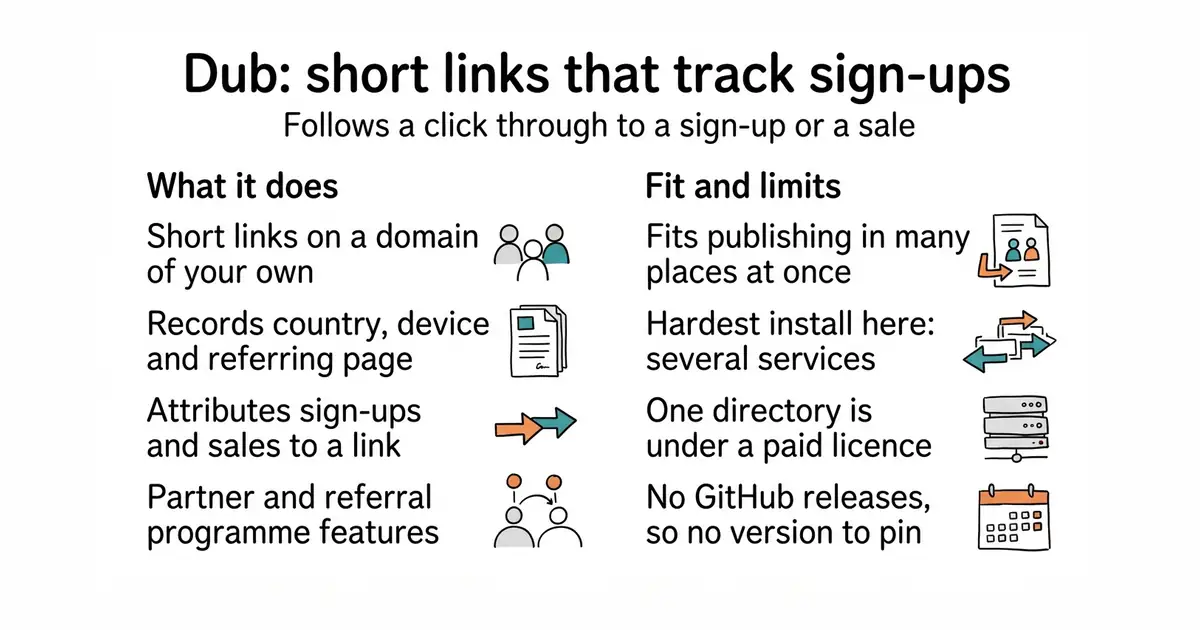
You point a short domain at it and create links through a dashboard or an interface for programs. Each click is recorded with the country, the device, the browser and the page that sent it. It can carry a click through to a later event, so a sign-up or a payment is attributed to the link that produced it. It supports partner and referral programmes, where someone else promotes a product and is paid for the customers they bring. It also makes link preview images and QR codes. Behind it sit PostgreSQL, Redis and a column store for the click records. What it does not do is give away everything: the main code is under the AGPL-3.0 licence, and one directory in the repository is under a separate commercial licence, so some features belong to the paid hosted service.
Why it matters
Who it suits. Anyone publishing in several places at once who cannot tell which place produces customers. One link per video, per post and per directory listing turns a guess into a count. It suits a marketing team more than a single person, because the partner and referral features assume several people are promoting the same thing. Skip it if a plain redirect is all you need, because simpler tools will do that in minutes. Skip self-hosting in particular if you want the result this week.
Verdict. Worth an hour, using the free hosted version rather than installing it. This is the honest recommendation and it matters: the self-hosted route needs a PostgreSQL database, a Redis cache, a column store and keys from several third-party services, and the project keeps the full instructions on a separate documentation site rather than in the repository. Getting the click data flowing today is worth more than owning the machine. At 24,864 stars it is well used and well documented, and code landed on 4 October 2026. Note that there are no releases on GitHub at all, so there is no version number to pin and the main branch is what you get. If you want something small you can run yourself in an evening, thedevs-network/kutt is the better fit.
Summary (Key Points)from the README
Key features
- Short links and conversion tracking: Dub Links is an open-source link attribution platform for short links and conversion tracking.
- Scale: The README says the platform powers 250M+ clicks and 12M+ links monthly.
- Enterprise adoption: The README names Twilio, Zillow, Jobber, Vercel and Raycast among teams using it.
- SAML/SSO: Single sign-on is provided through BoxyHQ.
- Analytics: Click analytics are handled by Tinybird.
- Monorepo: The project is organized with Turborepo.
- Self-hosting: You can self-host Dub for greater control over your data and design.
- Dev seed script: A script fills the database with development data, either by adding to existing data or after truncating it.
Ways to install
| Platform or method | What it needs | Effort |
|---|---|---|
| Self-hosting | Not stated in the README; it points to a separate self-hosting guide | Not stated |
| Local development | Node v23.11.0 and pnpm 9.15.9 are recommended; the database schema is pushed with pnpm prisma:push | Not stated; it points to a separate local development guide |
Important
- License: The core is AGPLv3, but the /ee directory is under a commercial license for enterprise features.
- Version pinning: The README recommends Node v23.11.0 and pnpm 9.15.9, and mismatched versions can break the local build.
- Stack dependencies: The stack relies on several third-party services, including Upstash, Tinybird, PlanetScale, Stripe, Resend and Vercel.
- Data loss risk: Running the seed script with --truncate deletes all existing database data, though it asks for confirmation first.
- Schema setup: If a table is missing, the README says to run pnpm prisma:push, which applies the schema without migration files.
Written by an AI model from the project’s README; not part of the review, and it can be wrong.
- It follows a click through to a sign-up or a sale, rather than stopping at the click.
- A short domain of your own reads as a real organisation rather than a generic shortener.
- Mature and heavily used, with documentation that covers both the hosted and the self-run routes.
- The hardest thing here to install: several services and keys from other companies before anything works.
- The AGPL-3.0 licence on the main code, plus one directory under a commercial licence, so part of it is reserved for the paid service.
- No releases on GitHub, so there is no version to pin and no release notes to read.
git clone https://github.com/dubinc/dub.git
cd dub
pnpm install
pnpm build
# then follow the self-hosting guide to fill in the service keys