279 stars · not shown on the GitHub page · astro-og-canvas@0.13.1 (2026-09-01) · Track this in Rising ↗
Generates OpenGraph preview images for every page of an Astro site automatically.
Radar check
What we found when we opened it. Every bar is one fact, with its date.
Last code pushed 25 Oct 2026, 2 days before this check.
Latest release astro-og-canvas@0.13.2 on 15 Sep 2026.
Public since September 2022, about 4 years.
288 stars and 27 forks.
45 commits and 0 new issues in the last 90 days.
17 contributors. 45 pull requests merged in 90 days.
No security policy file says how to report a problem. No published security advisories.
How the bars are scored
- Alive. Days since the last code push: a week or less 100, a month 90, three months 70, six months 50, a year 30, eighteen months 15, older 0.
- Releases. Age of the latest GitHub release, on a similar scale; no bar when the project publishes no releases.
- Maturity. Age of the project: eight years 100, five 90, three 70, two 55, one 40, six months 25, younger 10.
- Adoption. Stars on a log scale: 100,000 stars is 100, 10,000 is 80, 1,000 is 60, 100 is 40.
- Activity. Commits in the last 90 days: 300 or more 100, 100 85, 30 65, 10 45, any 25.
- Community. People who have contributed: 100 or more 100, 30 80, 10 60, 5 40, 2 25, one 10.
- Security. A published security policy 80, none 40; published advisories are listed, not scored.
Checked by Repo Radar on 25 Oct 2026 from the repository on GitHub. Covered in Edition 17.
▶Repo detailsthe review · specs · pros & cons · install
What it does
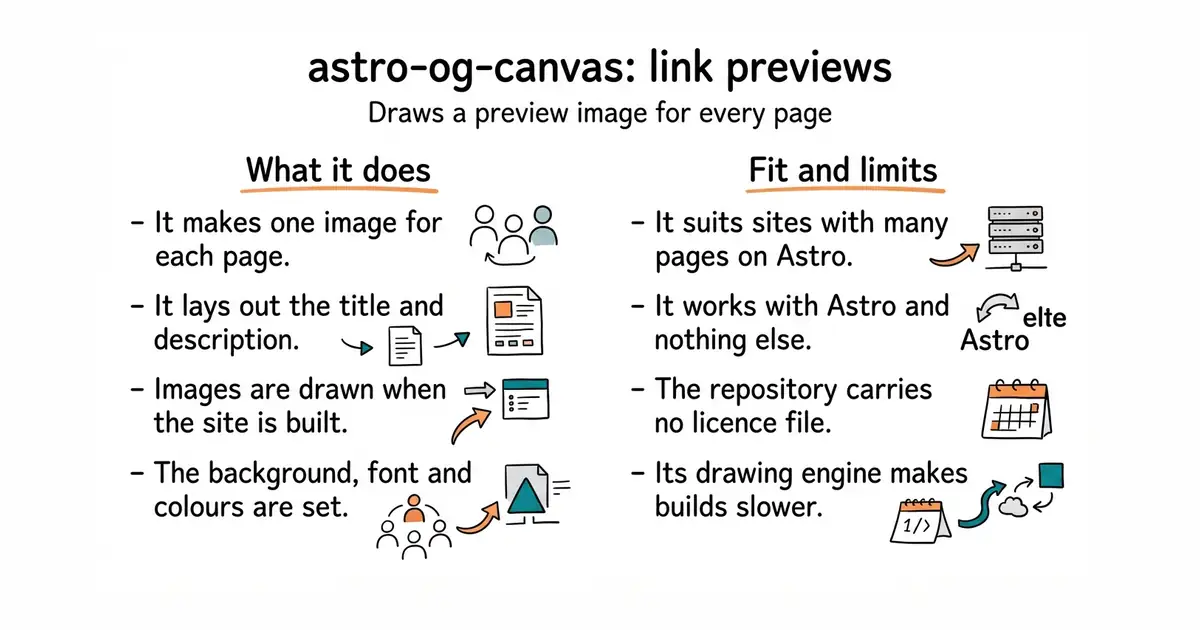
It is a small package for Astro, a website framework aimed at content-heavy sites. It generates one image per page when the site is built. You give it a background, a font, a logo and a set of colours, and it lays out the page title and description inside the standard 1200 by 630 frame. The pages it draws for are listed in one route file. Drawing is done by canvaskit-wasm, a drawing engine of several megabytes that is pulled in at build time only. Version 0.13.1 is the current npm release. It works with Astro and nothing else, and it draws from text you supply, so it cannot invent artwork or photographs.
Why it matters
Who it suits. Anybody publishing many pages on Astro who wants each shared link to look deliberate. A blog with eighty posts needs eighty preview images, and nobody draws eighty images by hand. Skip it entirely if the site is not built with Astro, because there is no way to use it.
Verdict. Worth twenty minutes on an Astro site, with one real reservation. The repository carries no licence file at all, and the npm package declares MIT. No licence means no permission by default, so the npm declaration is what anyone relying on it is relying on. The risk looks low, and the author is a well-known Astro maintainer, but the gap is worth knowing about before building something commercial on it. vercel/satori is the framework-independent way to do the same job.
- One small route file gives every page its own preview image.
- The images are drawn when the site is built, so nothing runs at request time and nothing costs money per view.
- The background, font, logo and colours are all configurable.
- No licence file in the repository. The npm package says MIT, and that mismatch is unresolved.
- Astro only. A site built on anything else cannot use it.
- It pulls in canvaskit-wasm, several megabytes of drawing engine, which makes builds slower. Visitors are not affected.
npm install astro-og-canvas canvaskit-wasm