26k stars · MIT or Apache-2.0 · @biomejs/biome@2.5.15 (2026-09-30) · Track this in Rising ↗
One fast tool that both formats and checks JavaScript, TypeScript, CSS and JSON.
Radar check
What we found when we opened it. Every bar is one fact, with its date.
Last code pushed 25 Oct 2026, 2 days before this check.
Latest release @biomejs/biome@2.6.3 on 24 Oct 2026.
Public since July 2023, a little over 3 years.
25,997 stars and 1,292 forks.
910 commits and 308 new issues in the last 90 days.
805 contributors. 879 pull requests merged in 90 days.
No security policy file says how to report a problem. No published security advisories.
How the bars are scored
- Alive. Days since the last code push: a week or less 100, a month 90, three months 70, six months 50, a year 30, eighteen months 15, older 0.
- Releases. Age of the latest GitHub release, on a similar scale; no bar when the project publishes no releases.
- Maturity. Age of the project: eight years 100, five 90, three 70, two 55, one 40, six months 25, younger 10.
- Adoption. Stars on a log scale: 100,000 stars is 100, 10,000 is 80, 1,000 is 60, 100 is 40.
- Activity. Commits in the last 90 days: 300 or more 100, 100 85, 30 65, 10 45, any 25.
- Community. People who have contributed: 100 or more 100, 30 80, 10 60, 5 40, 2 25, one 10.
- Security. A published security policy 80, none 40; published advisories are listed, not scored.
Checked by Repo Radar on 25 Oct 2026 from the repository on GitHub. Covered in Edition 17.
▶Repo detailsthe review · specs · pros & cons · install
What it does
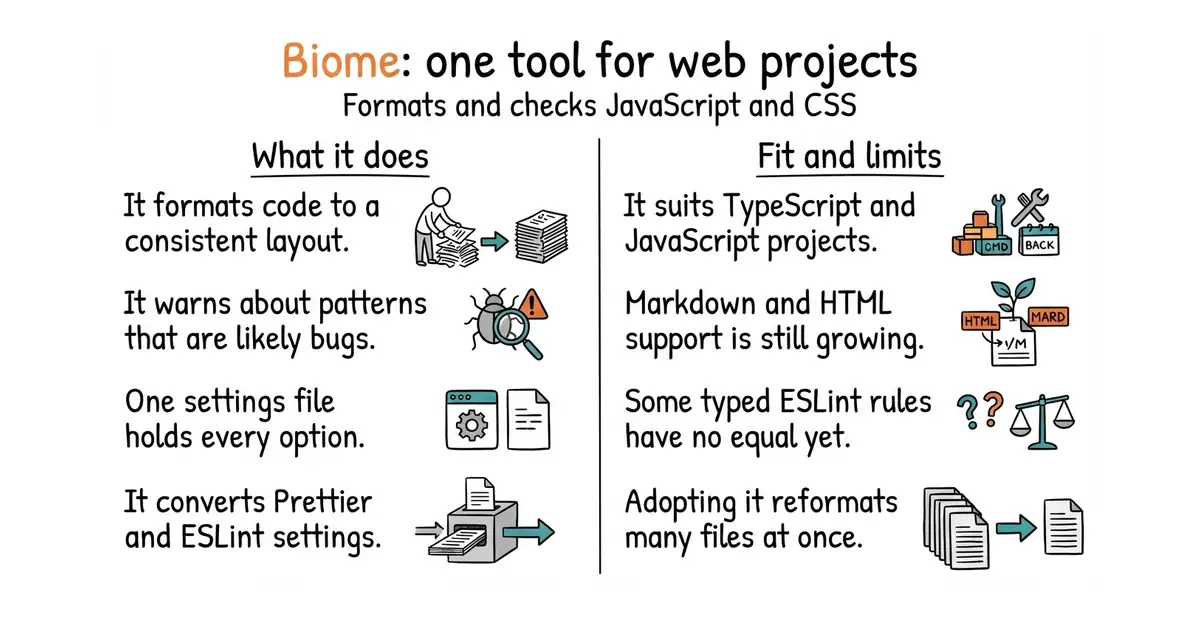
It formats code to a consistent layout, and it lints it, which means pointing at patterns that are likely to be bugs. It covers JavaScript, TypeScript, JSX, JSON, CSS and GraphQL. It is written in Rust and runs fast enough to be bound to the save key in an editor. One file, biome.json, holds every setting, and biome migrate reads an existing Prettier or ESLint configuration and converts it. It works from the command line and through the editor protocol that most editors speak. Version 2.5.15 was published on 30 September 2026, and code landed on 11 October 2026. Markdown and HTML are not covered to the same depth as the languages above, so a second formatter may still be needed for those.
Why it matters
Who it suits. Any project in TypeScript or JavaScript that currently carries Prettier for formatting and ESLint for checking. That is two tools with two configurations that disagree with each other at the edges. This is one tool with one configuration, and it is fast enough to stop being noticeable. Skip it if the project leans on ESLint rules that need full type information, because the equivalents are not all here yet.
Verdict. Worth the switch for most web projects, and the migration commands make it close to painless. One thing to plan: adopting it reformats a great many files at once, so do that on its own branch and in its own commit, never mixed with real work. oxc-project/oxc is the other fast Rust toolchain in this space and is worth watching; prettier/prettier remains the safer choice if broad format coverage matters more than speed.
Summary (Key Points)from the README
Key features
- Formatter: Formats JavaScript, TypeScript, JSX, JSON, CSS, GraphQL, Markdown, YAML, and SCSS, with 97% compatibility with Prettier.
- Linter: Provides more than 500 rules drawn from ESLint, typescript-eslint, and other sources, across the same set of languages.
- Diagnostics: Produces detailed, contextualized diagnostics meant to help you improve your code.
- Editor-first design: Built to run interactively in an editor, formatting and linting malformed code as you type.
- Zero configuration: Has sane defaults and does not require configuration to start.
- Standalone runtime: Does not require Node.js to function.
- LSP support: Offers first-class Language Server Protocol support, with a parser that keeps source text in full fidelity and recovers well from errors.
- Unified toolchain: Combines functions that were previously separate tools, sharing one base for error display, parallel work, caching, and configuration.
- Online playground: Lets you try Biome without installing it, via a version compiled to WebAssembly.
Important
- Prettier compatibility: The formatter scores 97% compatibility with Prettier, so output will not match Prettier exactly in every case.
- Language scope: The README lists the supported languages, and says the project "aims to support" all main languages of modern web development, so coverage is still a goal rather than complete.
- License: Biome is MIT licensed or Apache 2.0 licensed, and the project is moderated under the Contributor Covenant Code of Conduct.
Written by an AI model from the project’s README; not part of the review, and it can be wrong.
- One tool and one settings file instead of two that argue.
- Fast enough to run on every file save without waiting.
- It converts existing Prettier and ESLint settings automatically.
- It does not cover every language to the same depth. Markdown and HTML support is still growing.
- Some ESLint rules that depend on type information have no equal here yet. Check the list before switching.
- Adopting it in an existing project reformats many files at once, which makes one enormous commit.
npm install --save-dev --save-exact @biomejs/biome
npx biome init                  # writes biome.json
npx biome check --write ./src   # format and fix in one pass
# Coming from Prettier or ESLint:
npx biome migrate prettier --write
npx biome migrate eslint --write