2.9k stars · AGPL-3.0 · v2.8.0 (2026-08-22) · Track this in Rising ↗
Self-hosted support desk — live chat and email in one shared inbox, as a single Go binary against Postgres.
Radar check
What we found when we opened it. Every bar is one fact, with its date.
Last code pushed 25 Oct 2026, 2 days before this check.
Latest release v2.9.0 on 22 Oct 2026.
Public since May 2024, a little over 2 years.
3,078 stars and 322 forks.
856 commits and 79 new issues in the last 90 days.
41 contributors. 133 pull requests merged in 90 days.
A security policy says how to report a problem. 2 published security advisories.
How the bars are scored
- Alive. Days since the last code push: a week or less 100, a month 90, three months 70, six months 50, a year 30, eighteen months 15, older 0.
- Releases. Age of the latest GitHub release, on a similar scale; no bar when the project publishes no releases.
- Maturity. Age of the project: eight years 100, five 90, three 70, two 55, one 40, six months 25, younger 10.
- Adoption. Stars on a log scale: 100,000 stars is 100, 10,000 is 80, 1,000 is 60, 100 is 40.
- Activity. Commits in the last 90 days: 300 or more 100, 100 85, 30 65, 10 45, any 25.
- Community. People who have contributed: 100 or more 100, 30 80, 10 60, 5 40, 2 25, one 10.
- Security. A published security policy 80, none 40; published advisories are listed, not scored.
Checked by Repo Radar on 25 Oct 2026 from the repository on GitHub. Covered in Edition 5.
▶Repo detailsthe review · specs · pros & cons · install
What it does
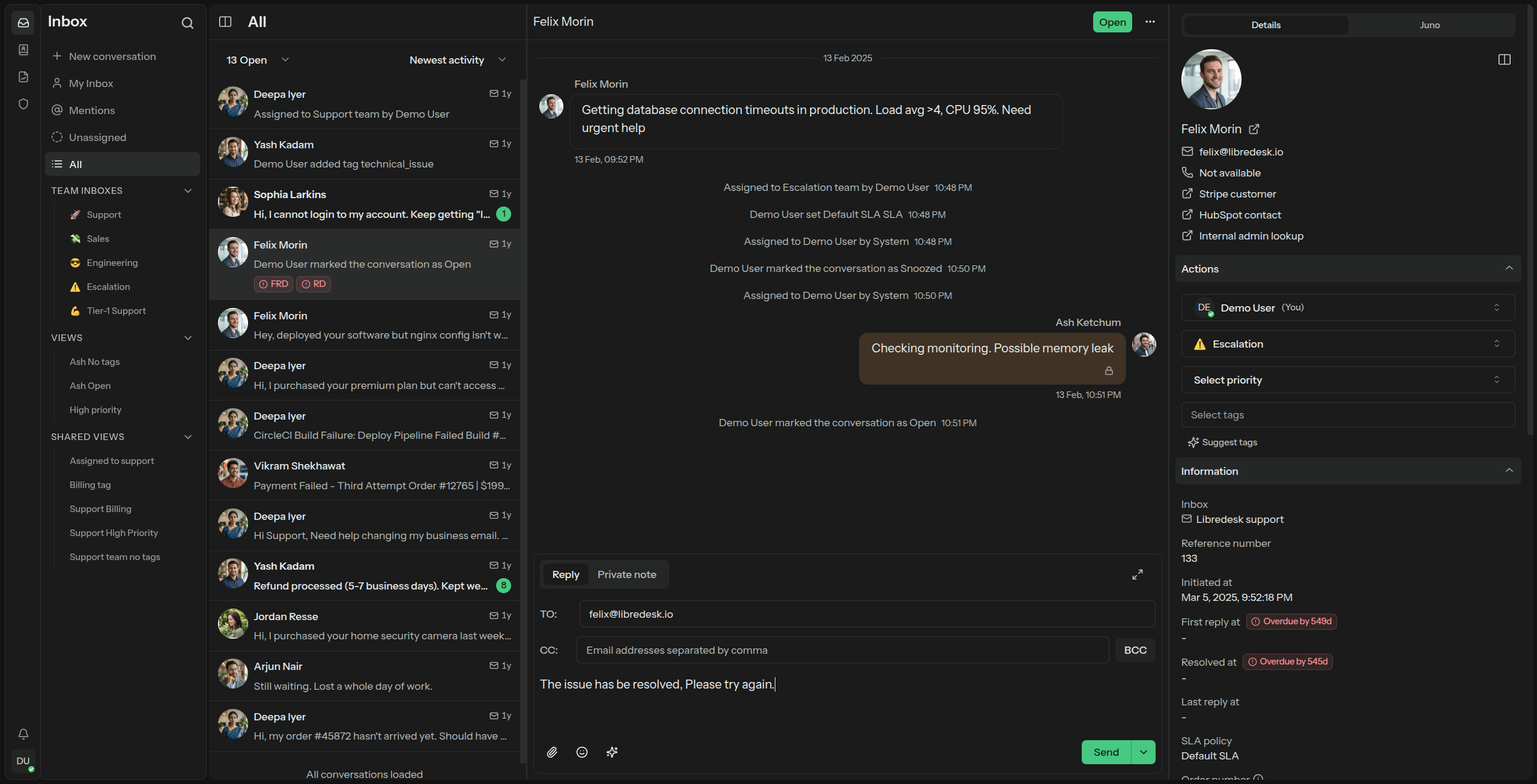
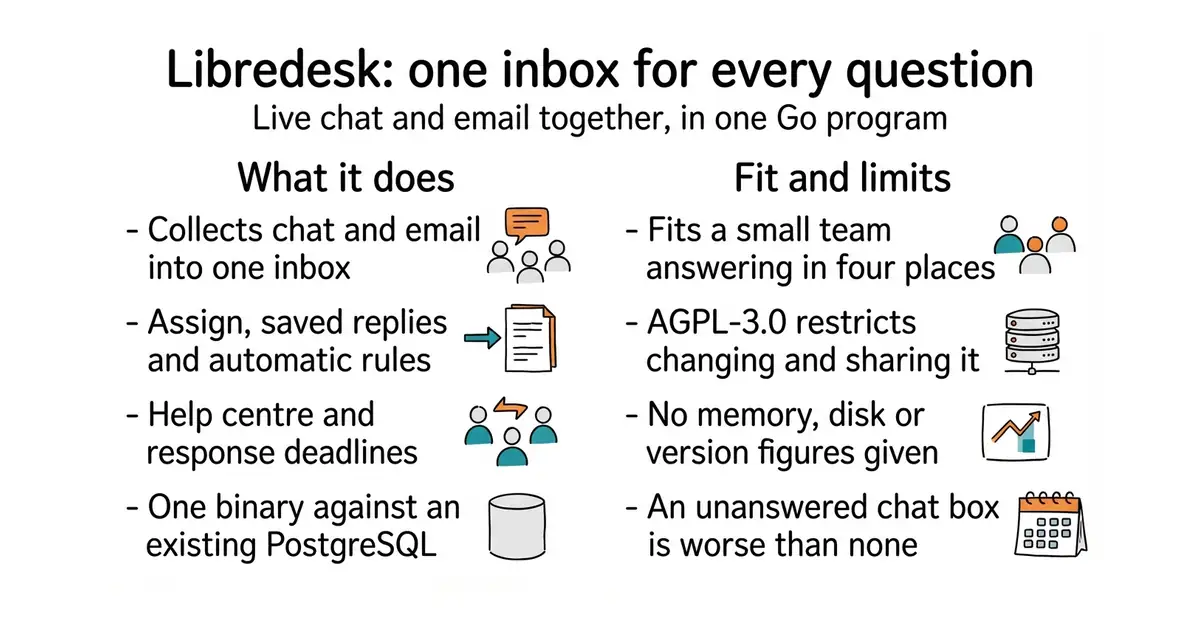
You install it against a PostgreSQL database and it creates its own tables. It then collects live chat from a widget on a site, and email from a mailbox, into one inbox. Conversations can be assigned to a person, answered with saved replies, and moved by rules that run when something happens. It tracks response deadlines, keeps a help centre of articles, and offers an answering assistant that replies from those articles. Sign-in can go through Google, Microsoft, or any OIDC provider, which is the standard way one login works across several tools. There is a JSON interface with webhooks, and an activity log. The backend is one Go program and the interface is Vue, so the whole thing is a single binary plus the database. What it does not do is state any limits: the README lists no unsupported cases, no minimum database version, and no memory or disk figures.
Why it matters
Who it suits. A one- or two-person team whose questions currently arrive in four places. It fits best where email is the main channel and chat is added later, because email needs nobody sitting at a desk. Skip it if the volume is a handful of messages a month, because an inbox tool adds work at that size. And skip it if the AGPL licence is a problem, which it will be for anyone wanting to change the code and ship it inside something else.
Verdict. Worth an evening, and the lightest thing in this layer by a wide margin: one Go program against an existing PostgreSQL, where the better-known alternatives want several containers. At 2,881 stars it is just inside what this report calls a hidden gem, and the 2.x line means the interfaces have settled. Three cautions. A chat widget nobody answers is worse than no widget, so switch it on only for hours when somebody is there. AGPL-3.0 is fine for running the tool as it comes and restrictive the moment the code is modified and offered to others, so read it before touching it. And nothing is published about how much memory or disk it needs, so the machine has to be sized by trial. The large alternative is chatwoot/chatwoot, which does more and costs considerably more to run.
Summary (Key Points)from the README
Key features
- Shared inbox: Handles email, live chat, and WhatsApp conversations in one place.
- Live chat: Adds a real-time chat widget to your website.
- WhatsApp: Connects a number through the Meta Cloud API.
- Inbox organization: Teams, tags, custom statuses, custom attributes, snoozing, and search.
- Help center and AI: A searchable, multilingual knowledge base, plus an AI assistant that answers live chat questions from it and hands off to an agent when needed.
- Agent copilot: Drafts replies, summarizes conversations, and finds answers without leaving the inbox.
- Automations and macros: Rules that tag, assign, and route conversations, and saved replies that apply conversation actions in one step.
- SLA, CSAT and analytics: Response targets with alerts for conversations at risk of breach, customer ratings, and reports on response times, resolution rates, and agent activity.
Ways to install
| Platform or method | What it needs | Effort |
|---|---|---|
| Railway (1-click deploy) | A Railway account; Railway provisions the app, Postgres, and Redis | Lowest |
| Docker | Docker, using the image libredesk/libredesk:latest from DockerHub | Low |
| Binary | A downloaded release, a Postgres database, and editing config.toml | Moderate |
Important
- Setup password: Docker and binary installs need you to set the System user password with --set-system-user-password before you can log in.
- Postgres dependency: The binary install runs --install to set up the Postgres database, so Postgres must be available first.
- Documentation: Detailed install steps live in the separate installation docs, which this README links to only by name.
Written by an AI model from the project’s README; not part of the review, and it can be wrong.
- One Go program plus an existing PostgreSQL: the lightest install of any tool in this category.
- Live chat and email in one inbox, so nothing depends on remembering which mailbox a question came to.
- A release on 22 August 2026, code on 5 September 2026, 68 open issues, and a 2.x version line.
- AGPL-3.0, which restricts changing the code and offering the result to other people.
- No published figures at all: no memory, disk or database-version requirements anywhere.
- Younger and thinner than the established desks: fewer connections to other tools and lighter reporting.
# Docker, the quickest route
mkdir libredesk && cd libredesk
curl -LO https://github.com/abhinavxd/libredesk/raw/main/docker-compose.yml
docker compose up -d
# Or the single binary against an existing PostgreSQL
./libredesk --install     # creates the tables
./libredesk               # starts the server