In simple English
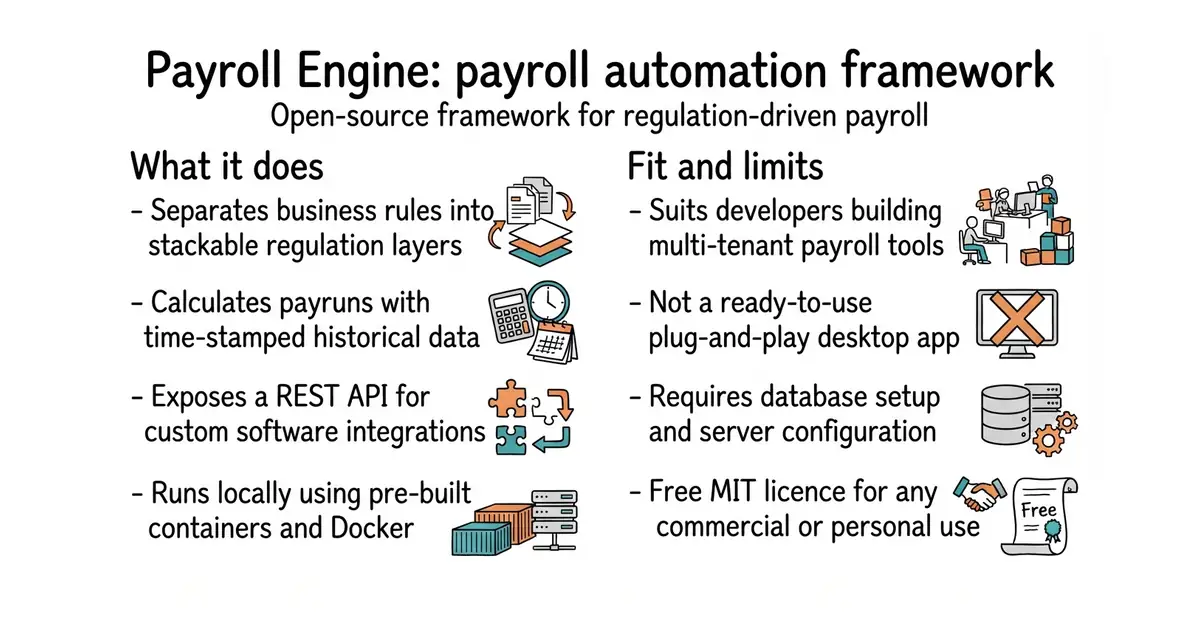
This tool helps software developers and companies build custom payroll applications. Instead of hardcoding complex tax laws and wage rules, you store them in separate configuration layers. It calculates salaries, handles historical corrections, and tracks employee changes over time. You can run it on your own server using Docker (a way to run a program inside its own sealed box, so it cannot break anything else on your server). It is free to use under an MIT licence.
What it is
Payroll Engine is an API-first framework for building regulation-driven payroll applications across multiple countries and industries. It separates business calculation rules from application code and supports Docker deployment.
What it is good for
Software companies and service providers who need to build, test, and scale custom payroll software for different clients without writing core calculation logic from scratch.
- Separates tax and wage rules from core application code.
- Supports retroactive calculations and historical data changes automatically.
- Provides pre-built Docker containers and a REST API for easy integration.
- Requires Docker and a SQL Server database to run locally.
- Built with .NET, so customizing deep backend logic requires C# knowledge.
- Split across multiple GitHub repositories, which can make debugging complex.
Hardcoding custom tax tables and manual spreadsheet payroll calculations
Docker
- hledgerorg/hledger4.8k stars
Double-entry accounting over plain text files, with command-line, terminal, web and editor interfaces.
- akaunting/akaunting10k stars
Self-hosted invoicing and expense tracking, with the double-entry accounting sold separately as an add-on.
- ledger/ledger6.1k stars
Double-entry accounting from a plain text file, run from the command line, with no database of any kind.
git clone https://github.com/Payroll-Engine/PayrollEngine.git
cd PayrollEngine
echo "DB_PASSWORD=PayrollStrongPass789" > .env
docker compose -f docker-compose.ghcr.yml up -d