2.6k stars · Apache-2.0 · 0.0.6 (2026-01-29) · Track this in Rising ↗
The /llms.txt spec — one small file that tells AI models what your product is. An hour of work, permanent upside.
Radar check
What we found when we opened it. Every bar is one fact, with its date.
Last code pushed 24 Sep 2026, 33 days before this check.
Latest release 0.0.7 on 24 Sep 2026.
Public since September 2024, a little over 2 years.
2,671 stars and 172 forks.
13 commits and 15 new issues in the last 90 days.
15 contributors. 1 pull requests merged in 90 days.
No security policy file says how to report a problem. No published security advisories.
How the bars are scored
- Alive. Days since the last code push: a week or less 100, a month 90, three months 70, six months 50, a year 30, eighteen months 15, older 0.
- Releases. Age of the latest GitHub release, on a similar scale; no bar when the project publishes no releases.
- Maturity. Age of the project: eight years 100, five 90, three 70, two 55, one 40, six months 25, younger 10.
- Adoption. Stars on a log scale: 100,000 stars is 100, 10,000 is 80, 1,000 is 60, 100 is 40.
- Activity. Commits in the last 90 days: 300 or more 100, 100 85, 30 65, 10 45, any 25.
- Community. People who have contributed: 100 or more 100, 30 80, 10 60, 5 40, 2 25, one 10.
- Security. A published security policy 80, none 40; published advisories are listed, not scored.
Checked by Repo Radar on 27 Oct 2026 from the repository on GitHub. Covered in Edition 2.
▶Repo detailsthe review · specs · pros & cons · install
What it does
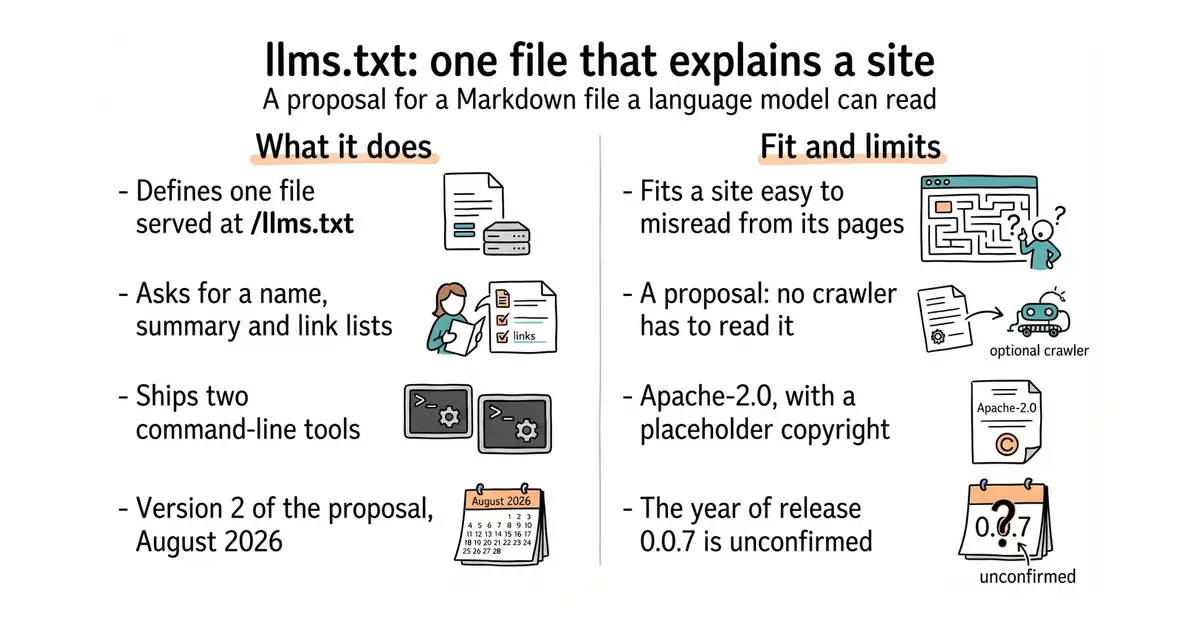
The specification describes the shape of the file. It asks for a first-level heading with the name of the site or project, and that heading is the only required part. After it come an optional short summary as a block quote, optional sections of detail, and optional second-level sections that are nothing but lists of links, each written as a name and an address with an optional note. A section headed "Optional" holds links an assistant may skip when it needs less material. The repository ships two command-line programs, llms_txt2ctx and llms_txt2html, and requires Python 3.10 or newer. What it does not do is replace anything that already exists: the project states that it is a proposal, that the specification is open for comment, that it serves a different purpose from a robots file, and that it is not a substitute for a sitemap.
Why it matters
Who it suits. Anybody with a site whose purpose is easy to misread from its marketing pages, which is most sites selling something new. The cost is one text file and an hour of thinking about how to describe the thing in plain words, which is useful work even if no model ever reads it. Skip it if the site has nothing a model would need to summarise, and skip it if nobody will keep the file current, because a stale file states something untrue.
Verdict. The cheapest item in this edition, and the one piece of work here that can be finished before lunch. The licence is Apache-2.0, read from the file, with one blemish worth recording: the copyright line is still the template placeholder, so no holder and no year are named, while the licence's own terms assume there is one. The important change since this edition first went out is that the specification is now at version 2, revised in August 2026 after what the author describes as two years of adoption, and the project publishes a page of what changed. A file written against the first version is not wrong, but it is worth half an hour to compare. The honest caveat stands: this is a proposal, not a ratified standard, and no crawler is obliged to read the file. Release 0.0.7 shows on the release page as 24 September with no year, and today neither the mirror nor the package index could be reached to settle it, so this report does not state the year. Code landed on 24 September 2026.
Summary (Key Points)from the README
Key features
- Root or path placement: The file can sit at the site root or at any subpath, covering the pages under that path, and agents should use the most specific file that applies.
- Markdown structure: An H1 with the project name is the only required section, followed by an optional blockquote summary, optional detail sections, and H2 "file lists" of links.
- Optional section: Secondary links go under an "Optional" heading so agents can skip them when they need a shorter context.
- Markdown page copies: Pages with useful information get a clean markdown version at the same URL, with .md appended (page.html.md) or the extension replaced (page.md).
- Standard link relations: rel="alternate" type="text/markdown" points to a page's markdown version, and rel="describedby" points to the llms.txt file that covers it.
- HTTP Link header option: The header form works for non-HTML files too and can be added in web server or CDN configuration without editing pages.
- Coexists with existing standards: It is positioned as a complement to sitemap.xml and robots.txt, and as an alternative to Well-Known URIs for sites that control only a path on a shared host.
- Generated automatically: The README says all nbdev projects create .md versions of pages by default, and lists Mintlify, GitBook, Yoast SEO, AIOSEO and Wix as platforms that can generate the file.
Important
- Informal proposal: The README describes the spec as open for community input and an informal overview, not a ratified standard.
- Depends on agents: Agents are expected to look up llms.txt and follow its links, so the benefit only applies where they do.
- Links should lead to markdown: Links should point to LLM-friendly content, and the file itself must stay small enough to fit in a context window.
- Built mainly for inference: The author expects use on demand while an agent helps a user, rather than for training, though training runs could use it too.
- Adoption figures come from the author: Claims such as "thousands of sites" and Lighthouse checks are the author's account and are not independently sourced in the README.
Written by an AI model from the project’s README; not part of the review, and it can be wrong.
- One text file, about an hour, and no infrastructure, dependency or ongoing cost.
- The specification is short enough to read in full, and version 2 ships a page explaining what changed.
- Apache-2.0, read from the file, and two small command-line tools for turning a file into context or into a web page.
- A proposal, not a standard. Nothing obliges any crawler to read the file, and the benefit is hard to measure.
- The Apache-2.0 file still carries the template placeholder instead of a real copyright line.
- The year of release 0.0.7 could not be confirmed from any second source today, and a stale file is worse than no file.
python3 -m venv venv
source venv/bin/activate
pip install llms-txt
# Turn an llms.txt file into one block of context
llms_txt2ctx llms.txt > context.md
# Or into a web page
llms_txt2html llms.txt > llms.html