
Free Repo vs Paid Software: Choosing the Right Tool
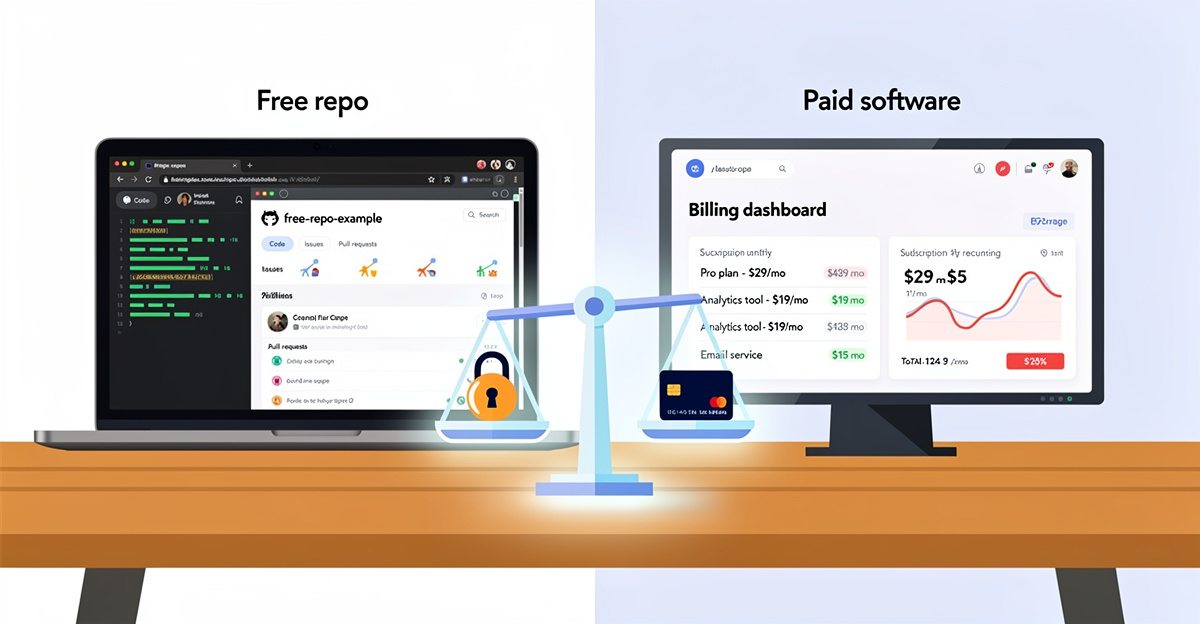
The bill I could not explain
I was paying every month and could not answer one question
Is there a free repo that does the same job as the tool I pay for every month? I couldn’t answer that about my own bill. I’m not a programmer. I build everything with Claude Code, and every new product quietly adds another subscription: one for email, one for sign-in, one for hosting, one for the thing that watches the other things.
The question sounds simple. It isn’t. To answer it I needed two lists for the same job, the paid tools and the free ones, with the real price next to each and some way to know whether that price was still true. Every time I tried, I ended up with a wall of browser tabs, pricing pages that changed their plan names between visits, and a GitHub search full of projects nobody had touched in years.
So I built the page I kept wishing existed. It’s called Stack Radar, it lives at grasppy.com/stack, and it opened on 19 October 2026. For every job a product needs, the paid tools worth paying for sit on one side, the free ones you can run yourself sit on the other, and the job sits in the middle. Solving it became the work.
Repo Radar showed me one side of the bill
The free side already existed. Repo Radar is my daily report of twelve open-source repositories, each opened and checked before it’s printed: last code, licence, latest release, whether anyone answers issues. It taught me that a lot of github free software is good enough to run a business on.
What it never told me was what I’d be giving up. A repository page doesn’t say “this replaces the $49 plan you’re on”. It can’t, because it doesn’t know what you’re paying for. I had a filter for free projects and no way to hold them up against the invoices.
Building got cheap and the subscriptions did not
AI coding tools changed the cost of building. A solo builder can assemble a working product over a weekend now, and I’ve done it more times than I want to count. The catch is that each weekend product is wired to five or ten paid services, and every one of them bills forever. Execution used to be the bottleneck. Now the bottleneck is knowing which of those bills you actually need.
Paid against free, by job, with a date on every fact
A vote is not a price, and a listicle is not a check
I looked at the usual places first. Product Hunt and Uneed are good at showing what’s new, and they rank by votes. A vote tells you a launch was popular on a Tuesday. It doesn’t tell you what the tool costs, what the free tier leaves out, or whether a free alternative exists.
“Best tools for X” articles are quicker to read and harder to trust, because the free self-hosted option rarely makes the list. Asking an AI chat is faster still, and the answer arrives with prices from its training data, no source and no date. The model is always very confident about a price it can’t date, which somehow makes it worse.
The idea fits in one line
I picked the shape on 14 October 2026: paid against free, organised by the job, not by the vendor. You start from “send transactional email” or “sign users in”, and you see both sides at once.
There are no votes and no ranking. The order on a page isn’t a verdict. The value is in what’s recorded for each tool: the checked plans and prices, what the free tier really includes, the date every one of those facts was checked, a written review, and the free alternatives for that job. If a fact is old, you can see that it’s old, which is more than most pricing pages will admit about themselves.
How a free repo ends up next to a paid tool
Scout reads every paid tool and dates what it finds
Every paid tool page is written by Scout, the research part of Grasppy. Scout opens the tool’s own website, reads the pages that matter, and records the plans, the prices, the free tier and the limits. Each fact carries the date it was checked. When a tool is published to Stack Radar, that date travels with it, so a page never pretends a September price is today’s.
Some websites refuse automated readers. Scout tries a second time through a paid reader for those, capped at 30 runs a month so the cap protects my bill as much as theirs. If a site still won’t answer, Scout says it couldn’t read it. It doesn’t guess. A page with a gap is honest; a page with an invented price is a liability with nice typography.
As of 20 October 2026 there are 643 paid tools published, the first of them on 13 October.
The free side comes from repositories that were actually checked
The free column isn’t a GitHub search. It comes from Repo Radar’s ledger, where every repository was opened and checked before it got anywhere near a reader. Each repository is then placed under the job it does, so a mail server lands next to the paid email services instead of in a generic “open source” bin.
There are 3,253 approved links between a job and a free repository right now, and 198 that I removed because the fit was wrong. On 18 October I moved 157 repositories into a job inside their own area, after noticing that a few had wandered into places they had no business being.
Why I say free and not open source
I chose the word on purpose. “Open source” is accurate and half my readers skip past it. “Free” is the word people use when they ask the question I was asking.
It comes with one honest line wherever it appears: free to use, you run it on your own server. That server costs money, and running it costs your time, sometimes a weekend, sometimes a weekend that becomes a month. So when someone asks me “is repo free”, my answer is that the code is, the hosting isn’t, and your evenings definitely aren’t.
Nothing goes public until I approve it
Research arrives in batches, and every batch waits on a Preview page until I read it and press Approve. The research for one job produces a feature comparison: what each tool does, the price marks, what was left out and why, and the gaps nobody covers. Twenty-two of those from an overnight run are waiting for me as I write this, which is the polite way of saying I have homework.
The whole site stayed hidden from 14 to 19 October because I decided it wouldn’t open until at least three jobs were complete: five or more published tools, the free alternatives linked, the page text written and the comparison done. The pages were built and uploaded in the background the entire time, so they were current the moment the switch flipped. That switch still exists. One setting in the database hides every Stack Radar page if something goes wrong, and a database hiccup can’t hide the site by accident. It’s scaffolding I needed to stay sane.
What it looks like when you use it
One job, paid on the left, free on the right
Transactional email was one of the first jobs to fill up, with five published paid tools. Open that page and the layout does the explaining. The paid services sit on the left with their checked prices and free tiers. The free repositories you can host yourself sit on the right. The job, and a short guide to choosing, sits between them.
The free list got long fast, so each panel now shows the first five and hides the rest behind “Show more”. Nobody needs forty mail servers before breakfast. I don’t even need forty mail servers after breakfast.
The traffic chart I pay for sits on every page
Every tool page carries a six-month traffic chart from SEO data that I pay for myself. It’s the closest thing I have to a pulse: a tool whose traffic is falling off a cliff is a tool I’d think twice about building on.
When I first saw the pages, the chart was squeezed into a corner. My note to my AI assistant was short: “It is such an important information… I specifically paying for this data.” It now sits on its own full-width row, about twice the size, across 532 tool pages. The fix overshot once and moved a box I wanted to keep, which earned the assistant my favourite review of the week: “Now you went too far. Did I ask you to remove this box?”
One paid tool can do several jobs
A few days in I noticed the obvious thing I had missed. “There are many paid tools that belong to multiple subcategories.” An all-in-one platform does email and analytics and forms, and filing it under one job hides it from people looking for the other two.
The answer was a list called Related paid tools. A tool keeps one home and appears as related wherever else it fits, instead of being copied into every job. An AI pass proposed the links and I chose to approve them automatically; there are 1,016 of them today. My assistant suggested running that pass every hour. “I think running every hour is way too often.” It now runs as part of the research, once, when the research happens.
Every failure ends in code
The rule behind the failure log
Stack Radar depends on reading other people’s websites, and other people’s websites are creative. So on 20 October I set a rule: every failure ends in a code fix, a regression test named after the real case, and a row in the failure log. Not a manual rerun. Not a note to look at it later.
By the end of that day the log had 35 rows. That number isn’t a confession. Each row is a kind of site that can no longer break the research the same way. I’m also extremely lazy, which is why I’m obsessed with automation, and fixing a class of failure once is much lazier than fixing it every Tuesday.
Some sites fight back
A few rows from that log explain the job better than any description. Publer sets a language cookie and redirects to itself, so a reader that forgets the cookie loops until it gives up with “Too many website redirects”. Scout now sends the cookie back to the same site, and never to another. Zilliz hid its whole page behind a tag manager snippet that the parser swallowed, and the report came back with zero pages read. Kling crashed the reader outright.
For Kling I gave my assistant one instruction: “Do not develop overkill solution based on Kling case.” It got per-page timeouts and a rule that one broken page can’t take the rest down with it. The temptation with a strange site is to build a framework around it. The better habit is to fix the class and move on.
The limits I will own
What Stack Radar will not do
It won’t rank tools and it won’t take votes. It won’t tell you which one is best, because best depends on what you’re building, how much time you have and how much you enjoy running servers. It shows what each option costs, what it includes, when that was checked and what the free alternative is. The decision stays yours, which is how I’d want it if I were the reader.
Most of it is still thin
There are 79 jobs in the catalogue and only some of them have approved research behind them. Prices change, and a checked date is only as useful as it is recent, which is why the date is printed instead of hidden. Some vendors block readers entirely, and those pages say so. The free side assumes you’re willing to host something. If you aren’t, the paid column is the honest answer, and I’d rather tell you that than pretend a free repo comes with free weekends.
Questions people ask
Is a repo free to use
Reading the code of a public GitHub repository is free. Using it depends on its licence, which Stack Radar and Repo Radar print instead of hiding. Running it costs a server and your time. So a free repo is free the way a free puppy is free.
Is GitHub free software good enough to replace a paid tool
Sometimes, and Stack Radar exists to show you when. For each job you see the paid tools and the free repositories side by side, with the checked prices on one side and the checked repositories on the other. If the free option needs a weekend you don’t have, the paid one is the cheaper choice.
How current are the prices
Each fact on a tool page carries the date it was checked. Scout records it when it reads the vendor’s own website, and it travels with the tool when it’s published. If a date looks old, treat the price as a starting point and check the vendor’s page before you buy.
Where should I start this week
Pick the subscription that annoys you most on your last invoice. Open its job on Stack Radar, read the free column, and check the line about running it yourself. If you’d like the free repositories to arrive on their own, Repo Radar sends twelve every morning.
If you keep paying after that, fine. It’s a decision now instead of a habit, which is basically the same bill with better posture.
Related posts
Top GitHub Repos in Self-Healing AI Pipeline
Explore top GitHub repos powering self-healing AI pipelines. Discover smart automation tools that reduce manual tasks and boost developer productivity.

AI Agent Collaboration: Two Agents Work Your Plan - Claude Codex
Discover how AI agent collaboration works when two agents relay and refine your plans together until they reach agreement on the best approach.
AI Chat History Sync for Claude & Codex on Mac
Free Mac app to sync your AI chat history from Claude, Codex, and Cursor. Back up conversations and code in one click—never lose your work.
 Powered by GRASPPY