151k stars · Open WebUI License - NOT open source. A BSD-style base with clause 4 added, which strictly prohibits altering, removing, obscuring or replacing any 'Open WebUI' branding. Waived below fifty end users in any rolling thirty-day period, with written permission from the copyright holder, or under a paid enterprise licence. Older code remains under its original licences, listed in LICENSE_HISTORY. Read directly from the LICENSE file on 17 September 2026 · v0.11.3 (2026-08-31), read from /releases/latest; the date showed no year and falls in the past, so 2026 · Track this in Scout
A self-hosted web interface for talking to AI models, with accounts, conversation history and document retrieval.
▶Repo detailsthe review · specs · pros & cons · install
What it is
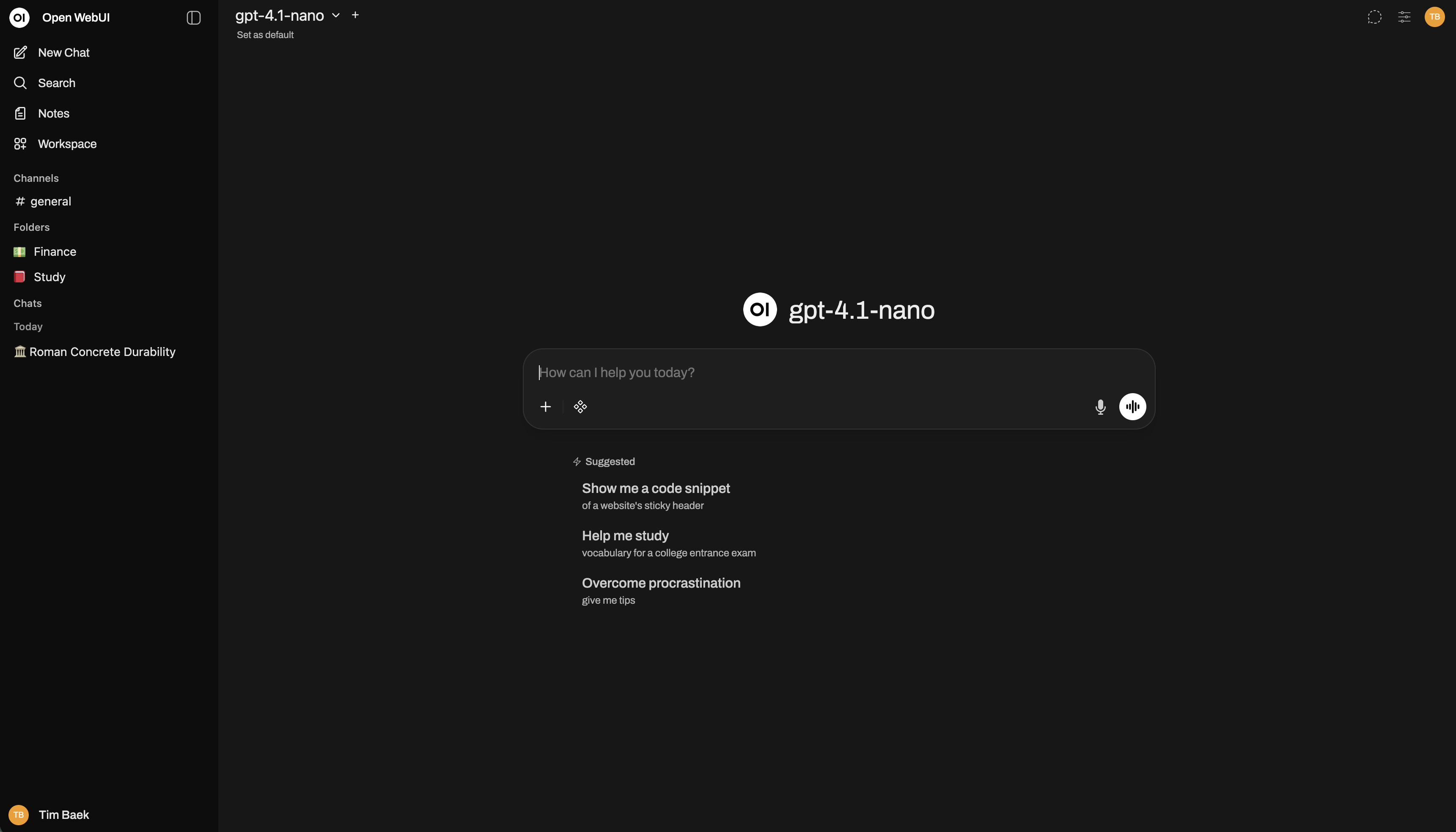
A self-hosted interface for large language models, written in Python and JavaScript. It talks to Ollama, which runs open-weight models on your own hardware, and to anything that speaks the OpenAI API, which covers most paid services. It has user accounts and permissions, conversation history, retrieval over documents you upload, web search, image generation, and a pipeline system for extending it. It is one of the most starred projects on GitHub, at about 151,000 stars.
What it is good for. Anyone who wants the convenience of a commercial chat screen without sending everything to a company. The problem it removes is the gap between a model running on your machine and something you would actually use every day. It is also the easy way to give two or three people access to one paid API key with a proper log of what was asked. Anyone building on a model can use it to try prompts against their own documents before any of that is written into an application.
- It works with local models and with paid services in the same screen, so you can switch by picking from a list.
- Document upload with retrieval is built in, so asking questions about your own files needs no extra software.
- It is very widely used, so almost every problem you hit has already been answered somewhere.
- The licence is not open source. It is the project's own licence, based on BSD, with clause 4 added: you are "strictly prohibited from altering, removing, obscuring, or replacing any 'Open WebUI' branding". It is waived below fifty end users in any thirty-day period, or with written permission, or with a paid enterprise licence. Parts of the older code are still under their original licences, listed in
LICENSE_HISTORY. - It is a large application. Expect a gigabyte or two of memory before any model is loaded, and models need much more.
- It ships no model. You still need Ollama on your machine or a paid key, and the real cost is whichever of those you choose.
- danny-avila/LibreChat
The same job under a plain MIT licence, with agents, many providers and no branding condition, and a smaller community.
Track this in Scout - oobabooga/text-generation-webui
Aimed at running and tuning the models themselves rather than at daily chatting, so it is the better workshop and the worse chat screen.
Track this in Scout  ggozad/oterm
The same idea in a terminal instead of a browser, with no accounts and nothing to host.
Track this in Scout
# With Docker, which is the supported way:
docker run -d -p 3000:8080 \
  --add-host=host.docker.internal:host-gateway \
  -v open-webui:/app/backend/data \
  --name open-webui --restart always \
  ghcr.io/open-webui/open-webui:main
# Or with Python, in a virtual environment:
python3 -m venv venv
source venv/bin/activate
pip install open-webui
open-webui serve
# Then open http://<your-server-address>:3000 .
# The first account you create becomes the administrator.
# Read the licence before putting this inside anything you sell:
#   https://github.com/open-webui/open-webui/blob/main/LICENSE